

Fun small cars are lightweight, agile automobiles designed to prioritize driver engagement, responsive handling, and high smile-per-mile value over raw horsepower. Characterized by compact dimensions, tuned suspensions, and manual gearboxes or punchy turbocharged engines, models like hot hatches and roadsters offer thrilling performance in everyday driving scenarios.
Have you ever squeezed into a tight parallel parking spot or navigated a twisty back road and realized that driving doesn’t have to feel like a boring chore? Choosing one of the best fun small cars brings pure excitement back into your daily commute without breaking the bank.
These lightweight automobiles combine nimble handling with punchy engine performance, proving that massive horsepower isn’t necessary to put a massive smile on your face. Driving fun small cars lets you enjoy legal road speeds while experiencing the go-kart sensation of responsive steering and athletic cornering.
Understanding the engineering magic behind compact performance helps you pick a vehicle that perfectly balances daily practicality with pure enthusiast joy. Adding one of these energetic rides to your garage turns ordinary grocery runs into memorable driving adventures.
Let’s explore top vehicle categories, handling physics, manual transmission perks, and practical buying tips for compact performance rides. Get ready to fall in love with driving all over again!
The Magic Formula: Why Compact Size Equals Maximum Driving Joy

There is a famous saying among automotive enthusiasts: “It is far more fun to drive a slow car fast than a fast car slow.” Small vehicles let you push the engine toward its limits on public roads without breaking traffic laws or risking safety.
Understanding the core mechanical principles behind compact agility explains why these lightweight machines deliver such incredible thrill.
Light Curb Weight and Lower Inertia
Heavy vehicles require massive brakes, stiff air suspensions, and giant tires just to manage their momentum around sharp corners. In contrast, a lightweight body experiences much lower cornering inertia, allowing the chassis to change direction instantly with minimal body roll.
When a vehicle weighs under 3,000 pounds, every movement feels sharp, communicative, and effortless. You feel connected directly to the road surface rather than isolated behind heavy electronic dampeners.
- Lower Inertia: Changes direction instantly without fighting massive gravitational forces.
- Shorter Wheelbase: Allows tighter turning radii and razor-sharp U-turns on narrow city streets.
- Smaller Footprint: Makes parallel parking and squeezing through tight traffic effortless.
- Efficient Tire Usage: Keeps tire replacement costs low while offering maximum cornering grip.
The Go-Kart Effect: Wheels at the Outer Corners
Pushing the four wheels out to the extreme corners of the chassis minimizes body overhangs in the front and rear. This mechanical layout creates an ultra-stable footprint similar to a racing go-kart.
With less weight hanging over the front and rear axles, the vehicle responds instantly to subtle steering wheel inputs. You get immediate feedback through your hands, allowing you to place the tires precisely where you want them.
Top Categories of Compact Enthusiast Vehicles

Small performance vehicles come in several distinct body styles, each offering a unique blend of practicality, style, and driving dynamics. Matching your lifestyle needs to the right chassis ensures you get maximum daily enjoyment.
Let’s break down the main categories dominating the enthusiast market today.
The Hot Hatchback: Ultimate Everyday Practicality
Hot hatches take standard three-door or five-door commuter hatchbacks and upgrade them with turbocharged engines, stiffened suspension springs, and upgraded brakes. Models like the Volkswagen Golf GTI, Ford Fiesta ST, and Mini Cooper S define this versatile category.
The major benefit of a hot hatch is its split personality. You can carry folding bicycles or flat-pack furniture through the rear liftgate on Saturday morning, then attack a windy mountain road on Sunday afternoon.
Lightweight Rear-Wheel-Drive Roadsters
Two-seater convertibles like the iconic Mazda MX-5 Miata represent pure, unadulterated sports car philosophy. By sending engine power exclusively to the rear wheels while keeping weight under 2,500 pounds, roadsters offer perfect 50/50 weight distribution.
Dropping the convertible top connects you directly to the surrounding environment, amplifying the sensation of speed even at modest limits.
Pocket Rockets and Micro-Performers
Micro-performers like the Abarth 500 or Suzuki Swift Sport take compact dimensions to the absolute extreme. These pocket rockets use short wheelbases and high-revving engines to deliver explosive fun in crowded urban centers.
Their small size lets you dart through city traffic with ease, making boring urban errands feel like laps on a local autocross course.
Manual vs. Automatic Transmissions in Small Vehicles

Choosing the right gearbox profoundly changes how you interact with a performance car. While modern automatic transmissions shift faster than any human can, manual gearboxes remain deeply cherished by driving purists.
Let’s evaluate how transmission choices impact your overall driving engagement.
The Joy of Three-Pedal Manual Gearboxes
Operating a clutch pedal and hand shifter requires physical coordination that forces you to pay close attention to engine sound and rev speeds. Successfully executing a smooth heel-toe downshift before a sharp corner delivers immense personal satisfaction.
In small cars with lower horsepower, a manual gearbox allows you to wring every drop of power out of the engine by holding gears all the way to redline.
Modern Dual-Clutch and Paddle-Shift Automatics
Modern dual-clutch transmissions (DCT) use two separate clutches for odd and even gears, pre-selecting the next gear for lightning-fast shifts in milliseconds. Steering-wheel-mounted paddle shifters give you manual control without requiring a clutch pedal.
For drivers who face heavy stop-and-go highway traffic daily, an automatic or DCT offers stress-free commuting while still providing rapid gear changes when you find an open road.
Cost to Own: Fuel Economy, Insurance, and Maintenance

One of the best arguments for buying a small performance vehicle is long-term affordability. Unlike heavy V8 muscle cars or high-maintenance alluring supercars, compact sporty cars keep routine ownership costs delightfully low.
Here is how smaller dimensions protect your monthly household budget.
Outstanding Fuel Efficiency
Because compact vehicles weigh significantly less than large crossovers and SUVs, their smaller four-cylinder engines do not have to work as hard to accelerate. Most hot hatches and roadsters achieve between 28 and 35 miles per gallon on the highway.
You get to enjoy spirited acceleration and energetic cornering without suffering high fuel bills at the gas pump every week.
Budget-Friendly Tires, Brakes, and Maintenance
Lightweight vehicles put far less stress on wearable mechanical components like brake pads, rotors, and rubber tires. Smaller wheel sizes—like 16-inch or 17-inch rims—mean replacement performance tires cost a fraction of the price of giant 20-inch SUV rubber.
Furthermore, mainstream brands use shared mechanical parts across millions of commuter vehicles, keeping replacement engine parts affordable and easy to source.
Practical Tips for Buying a Used Performance Compact
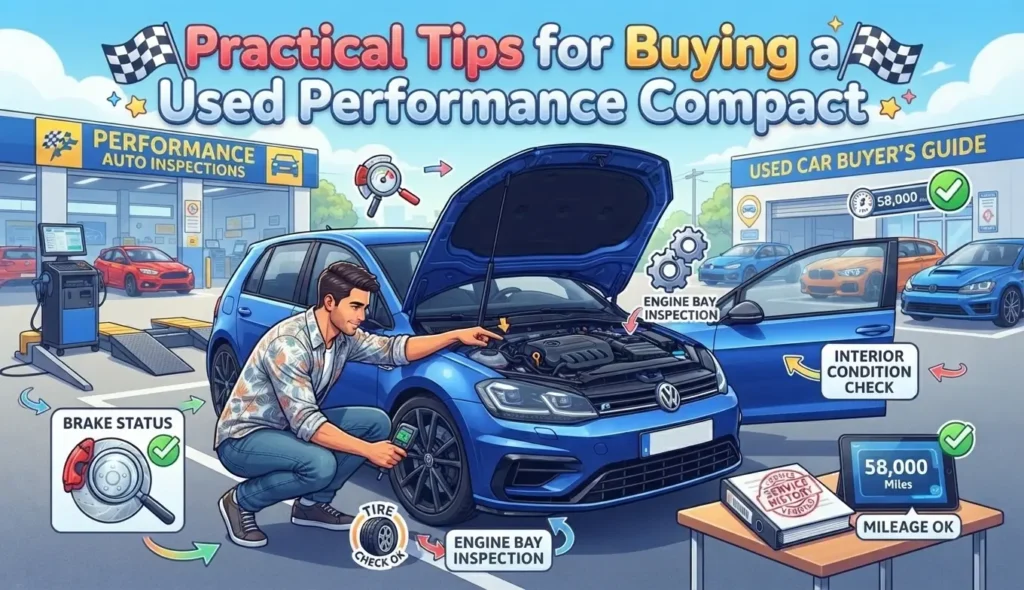
Shopping for a pre-owned performance vehicle requires careful inspection to ensure the previous owner maintained the mechanical components properly. Enthusiast cars are often driven enthusiastically, so verifying vehicle history is essential.
Follow these inspection steps before handing over your hard-earned money.
Checking for Modded Components and ECU Tunes
Many enthusiasts modify their vehicles with aftermarket cold air intakes, loud exhaust pipes, lower suspension springs, and Engine Control Unit (ECU) software tunes. While quality modifications can enhance performance, poor installation can reduce reliability.
Ask for original factory parts if available, or prioritize vehicles that have remained completely stock throughout their lifetime.
Inspecting Suspension Components and Clutch Wear
Take a thorough test drive over rough pavement and speed bumps to listen for clunking noises from suspension bushings or worn shock absorbers. Accelerate hard in a high gear at low engine speeds to verify that the manual clutch is not slipping.
Always request detailed service records proving regular synthetic oil changes, brake fluid flushes, and spark plug replacements.
Practice Exercise
Test your knowledge of compact performance cars, mechanical layouts, and vehicle maintenance with these 5 multiple-choice questions.
- What primary physical advantage gives lightweight vehicles sharp cornering response?
A. Higher overall vehicle height
B. Lower cornering inertia and reduced weight transfer
C. Extremely wide rear tailpipes
D. Heavy steel bumpers on the front end - Which body style combines the practicality of a folding rear liftgate with performance suspension and a turbocharged engine?
A. Luxury sedan
B. Full-size pickup truck
C. Hot hatchback
D. Convertible roadster - What mechanical layout feature helps roadsters achieve near 50/50 weight balance?
A. Front-engine placement sending power exclusively to the rear wheels
B. Mounting two engines over the front axle
C. Placing heavy iron weights inside the trunk space
D. Removing the front brake calipers completely - Why are replacement tires and brake pads generally cheaper for small cars compared to large SUVs?
A. Small cars use specialized wooden brake shoes.
B. Smaller wheel sizes and lighter vehicle weight put far less physical stress on wear components.
C. Tires for small cars are filled with water instead of pressurized air.
D. Federal laws require tire stores to discount small rubber products. - What potential issue should you check for when inspecting a used manual transmission vehicle?
A. A slipping clutch during hard acceleration
B. Automatic gear selector fluid leaks
C. Broken electric window motors in the rear doors
D. Melted plastic dashboard buttons
Answer Key:
- B
- C
- A
- B
- A
FAQs
Are small performance cars safe in crashes with larger SUVs?
Modern compact cars use high-strength steel safety cages, engineered crumple zones, and extensive curtain airbag systems to protect occupants effectively. While physics favors heavier vehicles, modern safety ratings ensure compact cars pass strict crash tests.
Can a tall person comfortably fit inside a small sports car?
Many compact vehicles, particularly hot hatchbacks, feature high rooflines and generous front legroom that accommodate drivers over six feet tall easily. However, low-slung roadsters may feel snug, so taking a test drive is crucial for taller drivers.
Is a rear-wheel-drive roadster safe to drive in winter snow?
Yes, RWD roadsters can handle winter conditions safely when equipped with four high-quality dedicated winter snow tires. However, low ground clearance can make deep, unplowed snowpack challenging compared to front-wheel-drive or all-wheel-drive options.
What is the difference between a hot hatch and a warm hatch?
A hot hatch offers high horsepower, aggressive suspension tuning, and track-ready brakes for maximum performance. A warm hatch offers moderate power increases and slightly firmer suspension over base models, balancing enthusiast fun with maximum daily comfort.
Do small sporty cars hold their resale value well?
Enthusiast vehicles with manual transmissions and strong reliability reputations often retain their value better than standard commuter cars. Desirable models in clean, unmodified condition frequently command strong prices on the pre-owned market.
Should I buy a front-wheel-drive or rear-wheel-drive sporty car?
Front-wheel-drive cars offer better traction in bad weather and roomier cabin packaging for daily driving. Rear-wheel-drive cars provide traditional sports car dynamics and neutral steering feel, making them preferred choices for pure dry-weather driving enjoyment.
Conclusion
Upgrading your daily drive with one of the best fun small cars brings incredible energy, sharp handling, and pure engagement back to every road trip. Combining lightweight construction, responsive steering, and budget-friendly maintenance creates an unbeatable formula for driving satisfaction.
Whether you choose a practical hot hatchback for daily errands or a lightweight open-top roadster for weekend canyon carving, these compact machines prove that less weight truly means more fun.
Find a clean local model, take a test drive on a windy road, and rediscover the simple joy of driving today!

Jack Olive is the creative mind behind buzzgiggles.com, a fun-focused website built to bring smiles, laughter, and lighthearted entertainment to everyday life. With a passion for humor and enjoyable content, Jack Olive creates and shares playful ideas, amusing stories, entertaining discoveries, and cheerful moments designed for readers of all kinds.
Through buzzgiggles.com, Jack Olive combines creativity, curiosity, and a positive sense of humor to explore the lighter side of life. Whether visitors are looking for a quick laugh, something interesting to share, or a cheerful break from their routine, the website offers content created with fun in mind. Jack Olive believes great entertainment should be easy to enjoy, memorable, and capable of brightening someone’s day.