
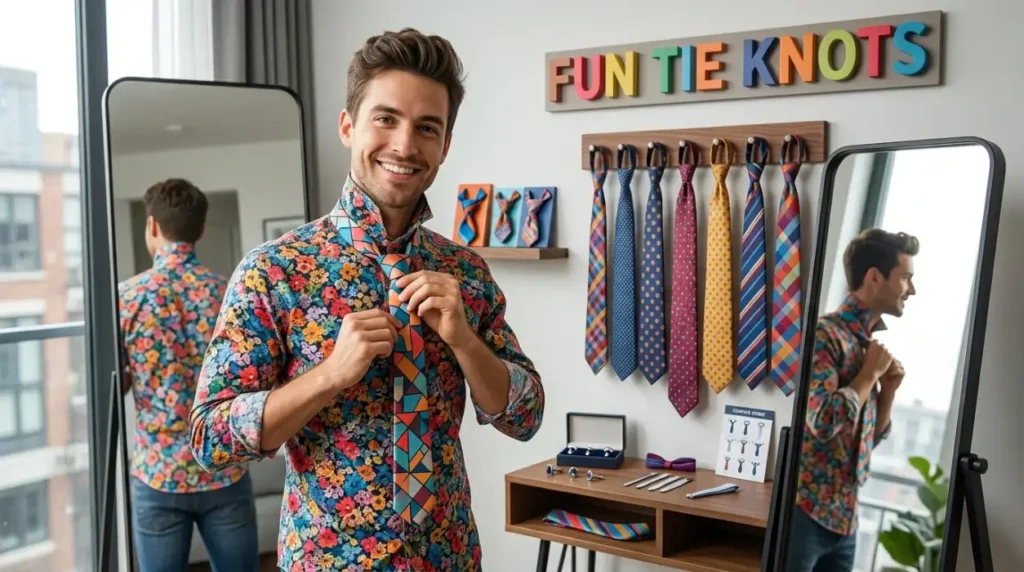
Mastering fun tie knots like the Eldredge, Trinity, and Cape knot allows you to transform standard neckwear into eye-catching conversation starters. By wrapping the narrow end of the tie in unique geometric patterns, you create sophisticated focal points perfect for weddings, parties, and stylish creative events.
Have you ever looked at a standard necktie knot in the mirror and thought it felt a bit predictable? Exploring fun tie knots is the ultimate secret weapon for injecting personality and flair into your wardrobe.
Whether you are dressing up for a summer wedding or a creative holiday party, learning a few fun tie knots will instantly set you apart from the crowd.
You do not need to be a master tailor or a magician to pull off these artistic styles with total confidence. Mastering a few unique wraps turns tying your neckwear into a playful, rewarding habit that gets people talking.
Let’s walk through simple steps, expert tricks, fabric recommendations, and styling secrets so you can start sporting these impressive knots right away.
The Evolution of Neckwear: From Military Uniforms to Art Forms
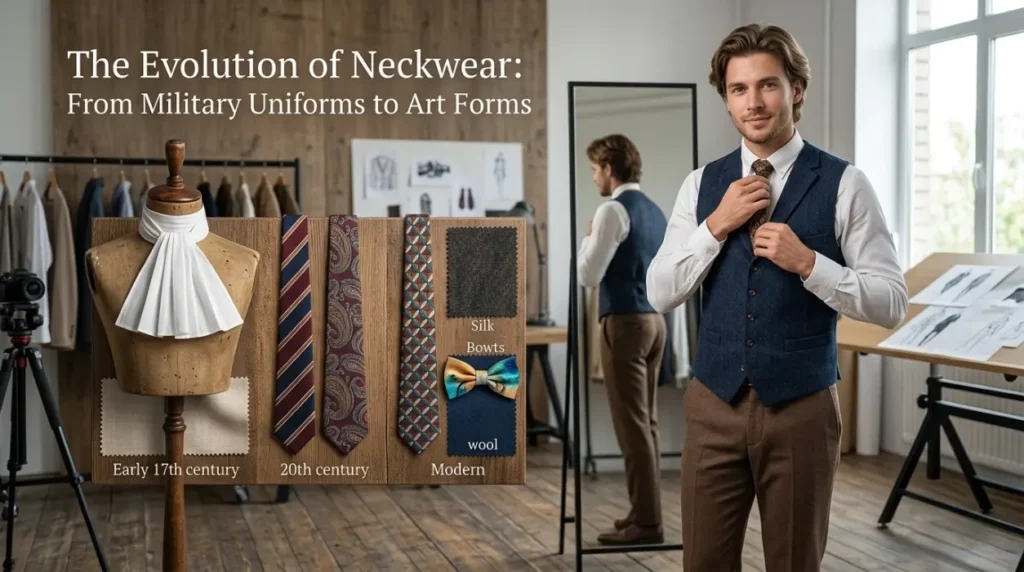
Neckties have come a long way since seventeenth-century Croatian soldiers wore decorative scarves around their necks for identification. What started as a simple functional cloth soon caught the attention of King Louis XIV in Paris, evolving into a symbol of elegance across Europe.
For generations, men stuck exclusively to basic styles like the Four-in-Hand or the classic Half-Windsor.
Modern neckwear enthusiasts now treat their ties like wearable artwork rather than strict workplace requirements. Geometric wrapping techniques show that menswear can be creative, expressive, and lighthearted while remaining completely sophisticated.
Why Unique Knots Are Making a Massive Comeback
In a world where workplace dress codes are becoming more casual, wearing a tie is now a deliberate personal choice rather than a corporate rule. Because wearing neckwear is optional, people choose to express themselves with bold patterns and complex geometric folds.
Standing out at a social gathering becomes effortless when your necktie features a woven, rosebud-like center.
- Immediate Icebreaker: Unique neckwear gives strangers a friendly, natural reason to compliment your style and start a conversation.
- Personal Expression: Choosing intricate wraps lets you highlight your creative personality without breaking formal dress codes.
- Vintage Charm: Many decorative techniques borrow weaving methods from traditional tailoring and mid-century formalwear.
- Visual Balance: Bold geometric knots balance widespread collars and strong jawlines beautifully.
The Mathematics Behind Modern Necktie Folds
Did you know that mathematicians at Cambridge University used computer models to calculate every possible necktie fold? They discovered that standard ties can produce eighty-four distinct knots using basic wrapping rules.
When you incorporate advanced wrapping techniques using the narrow end of the tie, the mathematical combinations explode into thousands of possibilities.
The Eldredge Knot: The Show-Stopping Masterpiece
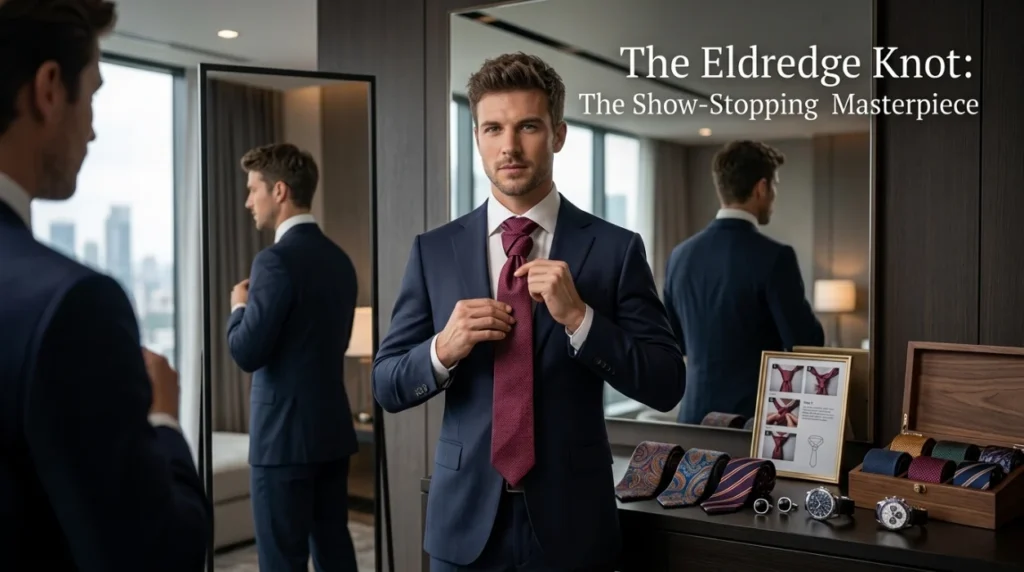
If there is one decorative tie style that reigns supreme across fashion blogs and wedding albums, it is the legendary Eldredge knot. Created by Jeffrey Eldredge in 2007, this intricate style resembles a blooming tulip or a foreign pinecone resting against your collar.
Unlike traditional methods that wrap the wide end of the necktie, the Eldredge is created entirely by wrapping the narrow tail.
Step-by-Step Guide to Tying the Eldredge
Before you begin, place the wide end of your tie exactly where you want it to finish, just touching your belt buckle. You will perform all wrapping movements using only the narrow tail of the fabric.
Pinch the wide end at your collar to form a clean center dimple before starting your wraps.
- Drape the tie over your neck so the wide end sits at your belt line and cross the narrow end over the front.
- Wrap the narrow end behind the wide end, then bring it up and down through the neck loop to form a secure base.
- Pull the narrow end horizontally across the front, loop it behind the neck band, and tuck it back through the front loop.
- Wrap the tail around the back of the knot, pull it up through the neck loop, and tuck it down through the side pocket you created.
- Tighten the woven layers gently, smooth out the fabric folds, and tuck the remaining thin tail neatly behind your shirt collar.
Best Shirts and Collars for the Eldredge
Because the Eldredge knot creates a large, dramatic focal point, it requires a shirt collar that provides adequate breathing room. A wide spread collar or a cutaway collar allows the intricate geometric weaves to sit flat against your chest without curling up.
Avoid button-down collars, as the plastic buttons overcrowd the sides of your woven masterpiece.
The Trinity Knot: Three-Fold Symmetry and Harmony
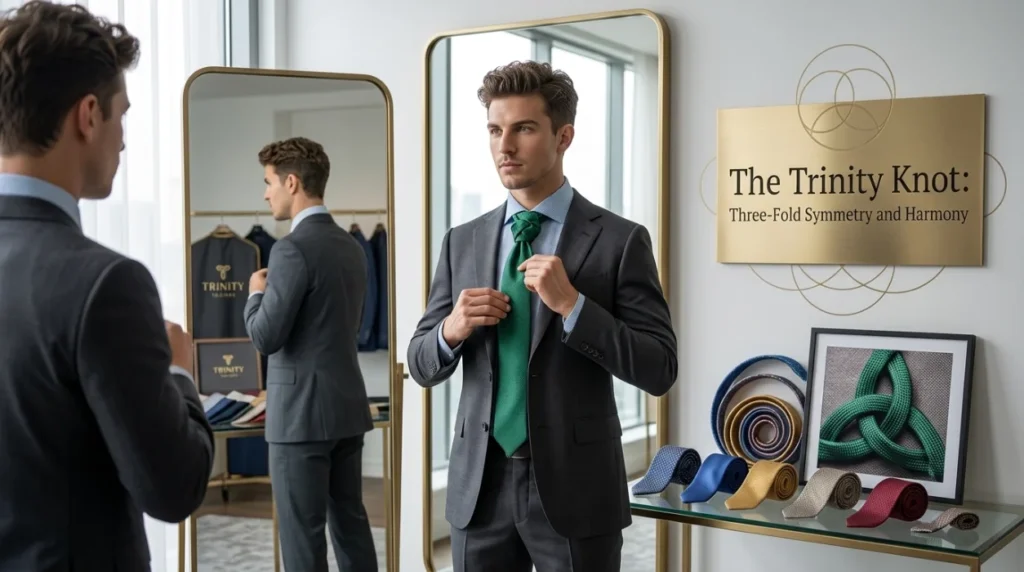
Named after the ancient Celtic triquetra symbol, the Trinity knot features a stunning three-way rotational symmetry. The folds converge into a central point, making it look like a sculpted piece of silk resting against your neck.
It is slightly easier to master than the Eldredge, making it a great entry point for decorative neckwear beginners.
Master the Trinity in Five Simple Phases
Start with the wide end sitting right at the top of your belt buckle, keeping it completely stationary throughout the process. Ensure your hands are clean and dry so you do not snag fine silk threads while pulling the fabric tight.
Working in front of a well-lit mirror helps you keep the three visual segments perfectly balanced.
Avoiding Common Flaws with Symmetric Knots
The biggest mistake beginners make with symmetrical styles is pulling the fabric too tight during the early steps. Keeping your wraps slightly loose allows you to slide the final tail through smoothly without crushing the lower layers.
Once all three sections are folded into place, adjust each section bit by bit until the pattern looks completely even.
- Check Fabric Tension: Keep your fingers relaxed so the silk glides smoothly through each loop.
- Align the Center Point: Ensure the three triangle points meet directly in the middle of your throat.
- Use Solid Colors: Patterned fabrics can look chaotic when twisted, while solid colors highlight the clean folded lines.
- Secure the Tail: Always hide the tiny leftover tail firmly inside your collar band, so it stays hidden all day.
The Cape Knot: Sleek Elegance for Monochromatic Outfits
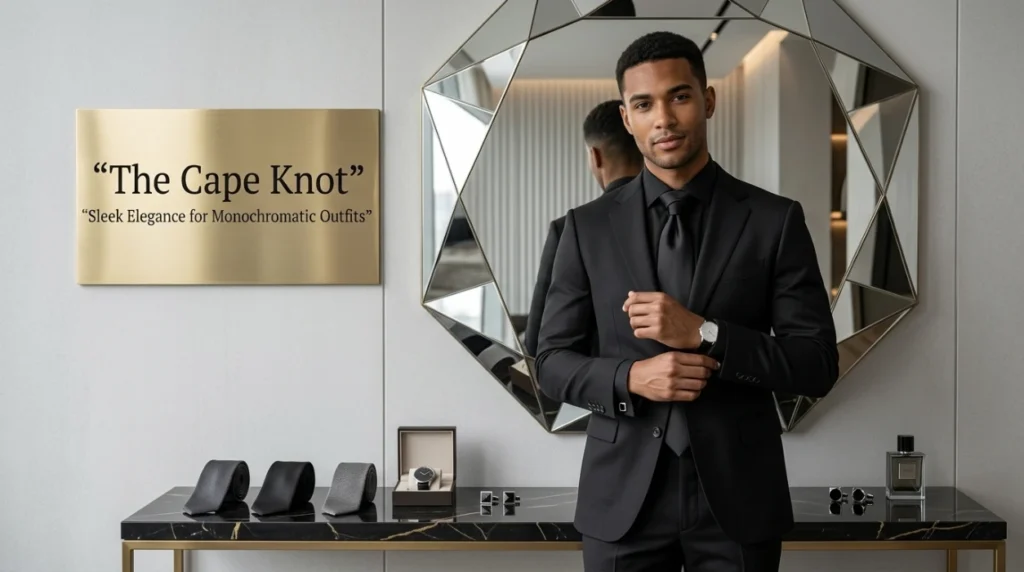
If you want a unique look that feels sleek rather than overly complex, the Cape Knot is a fantastic choice. This style creates a smooth, cape-like frame over the top of the main tie body, giving it a layered appearance.
It works exceptionally well for formal dinner parties, cocktail events, and holiday galas.
Step-by-Step Instructions for the Cape Style
Drape the necktie around your collar with the wide end resting near your belly button. Cross the narrow tail over the front, bring it behind, and pull it up through the neck loop to construct the upper frame.
Bring the tail down and drape it flat across the front face to form the smooth outer cape layer.
Next, loop the tail behind the main knot and pull it down through the top pocket you just formed. Pulling the tail snug seals the outer fabric layer smoothly across the front of your collar.
Adjust the collar wings down over the back loop to complete a clean, streamlined aesthetic.
Choosing Fabrics That Make the Cape Knot Pop
Textured fabrics like woven wool, linen blends, or matte silk give the Cape knot incredible depth and visual structure. Dual-color ties, where the front and back fabrics feature contrasting shades, create a striking two-tone effect when draped.
Steer clear of thick leather or heavy knitted ties, as they create bulky folds that look awkward around your throat.
The Matrix Connection: The Legendary Merovingian Knot
Pop culture enthusiasts often recognize the inverted “Merovingian” or “Ediety” knot from sci-fi cinema history. This futuristic style makes the tie look as if it is wearing its own miniature necktie around its neck.
It is tied by wrapping the wide end over the narrow end in reverse, creating a layered collar effect that commands attention.
- Positioning: Hang the narrow end over your chest while leaving the wide end twice as long on your dominant side.
- Inverted Base: Cross the wide end behind the narrow end to begin building the hidden internal structure.
- Front Fold: Pull the wide end up over the front and tuck it down through the neck loop toward your waist.
- Final Drape: Wrap the wide end around the front to create a collar, tucking it through the back so the tail drapes forward.
Choosing the Right Accessories and Collars

An extraordinary necktie technique loses its impact if the rest of your outfit clashes with the knot’s proportions. Understanding how collar shapes, tie bars, and jacket lapels interact ensures your overall appearance remains sharp and intentional.
Let’s look at how to frame your neckwear so your artistic effort looks like a high-end styling choice.
Matching Collars to Decorative Knots
Large, intricate styles need wide collar spreads so the fabric lies completely flat against your dress shirt. Narrow point collars squeeze bulky folds together, causing the shirt fabric to pucker and buckle awkwardly beneath your chin.
If you prefer wearing standard point collars, stick to sleeker decorative styles like the Cape knot or Atlantic fold.
Why You Should Skip the Tie Bar
Standard tie bars are designed to slide across traditional single-layer knots to anchor them to your shirt placket. Intricate, multi-layered wraps create extra fabric thickness that can bend standard metal tie clips out of shape.
Furthermore, a shiny tie bar competes visually with the knot itself, creating a crowded appearance near your chest.
- Let the Knot Shine: Keep your shirt simple and pattern-free so your neckwear remains the undisputed hero of your outfit.
- Use Pocket Squares Wisely: Fold a plain white cotton pocket square neatly into your jacket pocket to balance your chest area.
- Check Suit Lapel Width: Match wide, dramatic folds with medium to wide jacket lapels for proper visual scale.
- Mind the Fabric Weight: Medium-weight silk provides the perfect flexibility for crisp, sharp, non-bulky folds.
Practice Exercise
Test your understanding of tie styling techniques, fabric choices, and collar pairings with these 5 multiple-choice questions.
- Which part of the necktie is primarily used to wrap and construct the Eldredge knot?
A. The wide end of the tie exclusively.
B. The narrow end (tail) of the tie.
C. A separate silk ribbon attached to the shirt collar.
D. Both ends wrapped simultaneously in equal loops. - Which collar style provides the best visual framing for large, intricate styles like the Eldredge?
A. Button-down collar.
B. Pin collar.
C. Wide spread or cutaway collar.
D. Narrow club collar. - Why are solid-colored ties generally recommended over busy patterns for complex geometric knots?
A. Solid colors are cheaper to buy than patterned ties.
B. Busy patterns make complex folds look messy and obscure the woven detail.
C. Patterned ties are illegal to wear at formal evening events.
D. Solid colors automatically shrink the thickness of heavy silk fabric. - What ancient symbol inspired the three-way rotational symmetry of the Trinity knot?
A. The Egyptian Ankh.
B. The Celtic Triquetra.
C. The Roman Laurel Wreath.
D. The Greek Infinity Loop. - Why should you usually avoid wearing a traditional metal tie bar with a multi-layered decorative knot?
A. Metal clips damage the silk thread permanently.
B. The extra fabric thickness can bend clips, and it creates visual clutter near your chest.
C. Tie bars can only be worn with bowties.
D. The weight of the metal clip makes the tie fall off your collar.
Answer Key:
- B
- C
- B
- B
- B
FAQs
Are creative, complex tie knots appropriate for formal business meetings?
Traditional corporate environments usually prefer understated styles like the Half-Windsor or Four-in-Hand. However, creative industries, weddings, galas, and festive social gatherings are ideal settings to showcase unique neckwear styles confidently.
What tie length do I need to tie an Eldredge knot successfully?
Standard ties work fine for most men, but taller individuals may prefer an extra-long necktie. Because decorative styles use multiple wraps with the thin tail, having extra fabric length ensures you do not run out of material mid-wrap.
Can I tie these complex styles using a clip-on tie?
No, clip-on ties have pre-tied, rigid structures that cannot be re-folded or unwrapped. You must use a standard, self-tie necktie made of flexible fabric to construct custom geometric folds successfully.
How do I prevent my tie from wrinkling after wearing an intricate knot?
Gently untie the wraps in reverse order when taking off your tie, rather than pulling the thin tail forcefully through the structure. Hang your tie on a smooth wooden rack overnight to allow natural silk fibers to relax and shed light creases.
What tie fabric is easiest for beginners to practice with?
Smooth, medium-weight silk or synthetic microfiber with a light sheen is easiest for practicing new wrapping techniques. These materials glide easily through loops without grabbing or friction, making tightening and adjusting simple.
Conclusion
Exploring fun tie knots opens up a world of personal style, creativity, and self-expression, turning dressing up into an enjoyable ritual. From the floral elegance of the Eldredge to the clean symmetry of the Trinity, these artistic techniques ensure you leave a lasting impression.
With a little patience in front of the mirror, turning ordinary silk into wearable artwork becomes second nature.
Grab your favorite solid silk tie, pick a style from this guide, and start mastering your new favorite conversation starter today!

Jack Olive is the creative mind behind buzzgiggles.com, a fun-focused website built to bring smiles, laughter, and lighthearted entertainment to everyday life. With a passion for humor and enjoyable content, Jack Olive creates and shares playful ideas, amusing stories, entertaining discoveries, and cheerful moments designed for readers of all kinds.
Through buzzgiggles.com, Jack Olive combines creativity, curiosity, and a positive sense of humor to explore the lighter side of life. Whether visitors are looking for a quick laugh, something interesting to share, or a cheerful break from their routine, the website offers content created with fun in mind. Jack Olive believes great entertainment should be easy to enjoy, memorable, and capable of brightening someone’s day.