
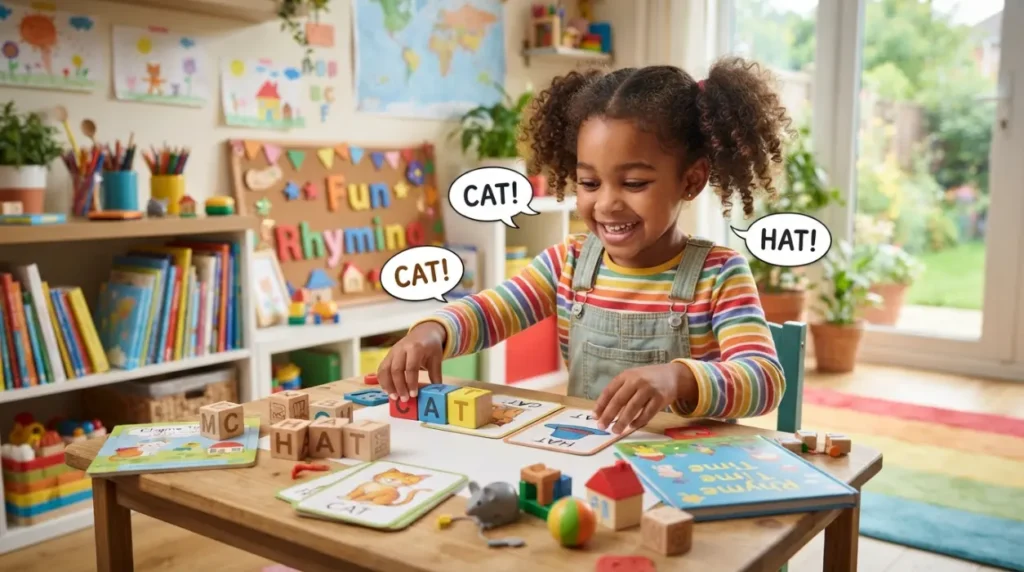
Fun rhyming is the playful pairing of words with matching end sounds to create musical, memorable language. Used in songwriting, poetry, children’s literature, and language learning, it builds phonological awareness, boosts vocabulary retention, and turns written communication into an enjoyable, creative experience for learners and writers of all ages.
Have you ever caught yourself singing a silly song in the shower or making up goofy couplets with a friend? Exploring the art of fun rhyming turns everyday language into a playful game that sparks instant joy and creativity.
Words carry rhythm, music, and energy that awaken our brains the moment we pair matching sounds together. Engaging in fun rhyming activities helps kids learn to read faster while helping adults write catchy lyrics and memorable social posts.
Whether you are writing nursery rhymes, composing rap hooks, or just looking to stretch your creative muscle, wordplay feels natural. Tapping into fun rhyming techniques gives you a fresh way to express thoughts with confidence and charm.
Ready to trade dry vocabulary drills for clever couplets, rhythmic word games, and musical writing tricks? Let’s take a closer look at how simple sound patterns transform how we write, speak, and remember information every day.
The Magical Science Behind Rhyme and Memory
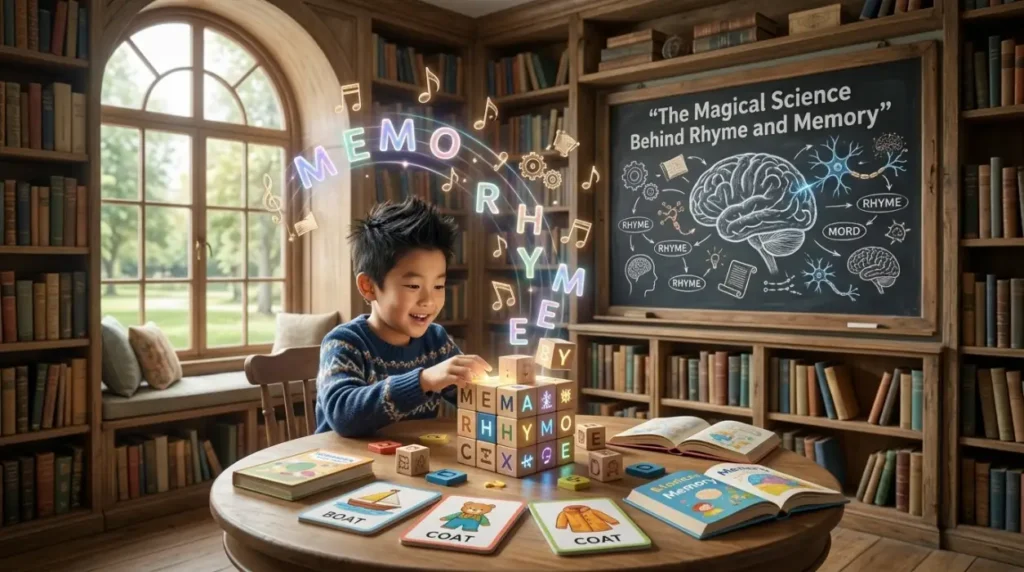
Why do we remember song lyrics from twenty years ago while forgetting what we ate for breakfast yesterday? The answer lies in how our neural pathways process acoustic patterns, cadence, and sound structures.
When words share ending vowels and consonants, your brain groups them into predictable mental packages. This acoustic link lowers cognitive load, making it effortless to recall complete phrases after hearing them only once or twice.
Playing with sound patterns activates both analytical and creative regions of your brain simultaneously, creating strong memory anchors.
How Phonological Awareness Builds Early Literacy
Long before children understand letters or grammar rules, their ears detect differences in spoken pitch and sound endings. Recognizing that “cat,” “hat,” and “mat” belong together builds essential phonological awareness.
- Ear Training: Hearing rhymes teaches young listeners to segment words into individual sound units called phonemes.
- Predictive Reading: Anticipting the final word of a rhyming sentence boosts reading confidence in early learners.
- Vocabulary Expansion: Searching for rhyming matches naturally introduces lesser-known words into daily speech.
Why Rhythm and Cadence Stick in Our Brains
Human memory relies heavily on pattern recognition, and rhyme provides an instant structural template. When sound matches combine with a steady beat or meter, language becomes musical notation that the brain stores effortlessly.
This built-in musicality explains why ancient cultures used oral poetry to pass down historical events and legends across generations without written books.
Understanding Different Types of Rhyme Structures
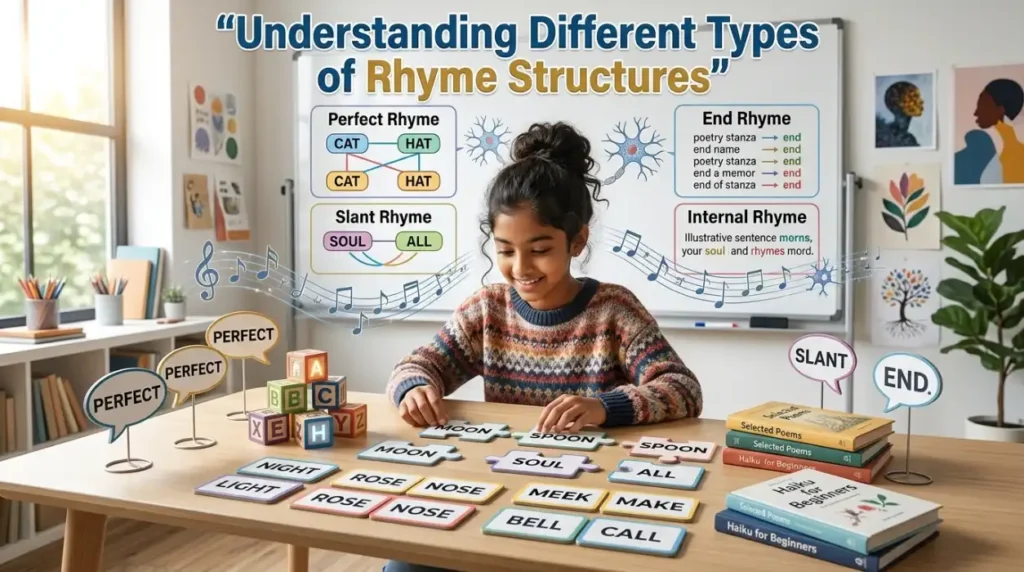
Not all rhymes sound identical, and knowing the differences helps you write far more interesting poetry and prose. Expanding your toolkit beyond simple exact matches gives your writing variety and modern flair.
Exploring various sound pairings allows you to craft subtle emotional tones without sounding like a greeting card.
Perfect Rhymes vs. Slant Rhymes
Perfect rhymes occur when the stressed vowel and all following consonant sounds match completely, as seen in “bright” and “kite.” While satisfying, relying exclusively on perfect rhymes can make your writing feel predictable over time.
Slant rhymes, also called near or slant matches, pair words with similar but non-identical sounds like “cloud” and “shout.” Using slant rhymes grants you massive creative freedom, unlocking thousands of word choices that traditional dictionaries miss.
Internal Rhyming for Dynamic Rhythm
Most beginners place rhyming words exclusively at the very end of line breaks. However, scattering rhyming sounds inside the middle of your sentences creates an energetic, bouncy movement.
Notice how internal sound matching creates momentum: “The cool cat sat on the mat with a bright red hat.” The internal beats push the reader forward rapidly without feeling forced.
Fun Rhyming Games for Kids, Classrooms, and Families
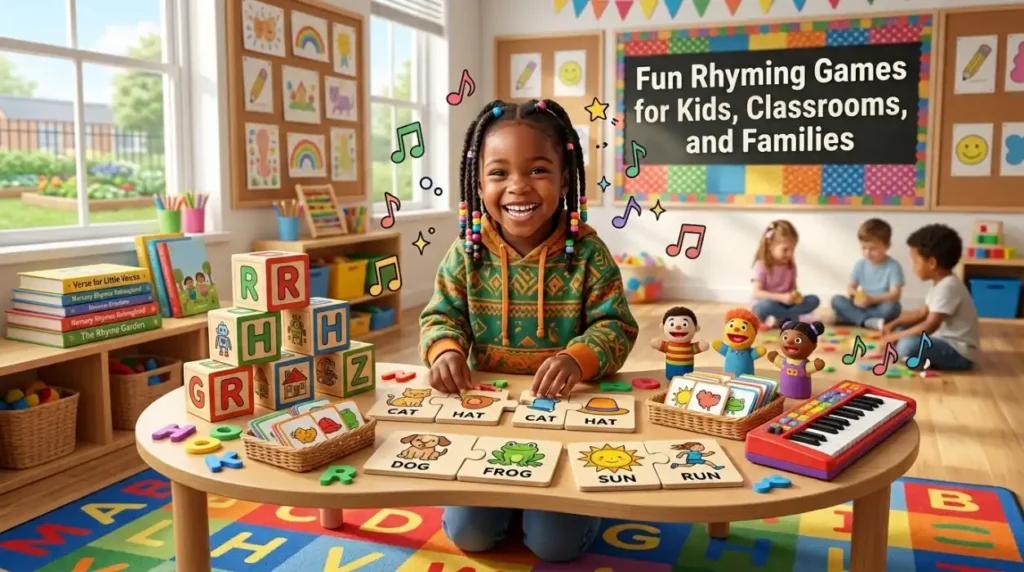
Bringing interactive word games into your daily routine turns learning into a laughter-filled social activity. You do not need expensive board games or digital apps to practice wordplay effectively with young learners.
Simple verbal challenges work wonders during car rides, dinner prep, or quick classroom brain breaks.
The Word Chain Challenge
Gather players in a circle and pick a simple starting word like “ball.” The first player says “tall,” the next says “wall,” and play continues clockwise around the circle.
- Players must shout out a valid matching word within five seconds.
- Repeating a word that was already said eliminates the player for that round.
- The game speeds up with each rotation, turning simple vocabulary recall into a fast-paced reaction challenge.
Rhyme Detective: Scavenger Hunts at Home
Transform your living room or classroom into a giant detective puzzle. Give children a clue card containing a simple word, such as “sock,” and ask them to search the room for an object that rhymes with it, like a “clock.”
Physical movement paired with acoustic problem-solving helps tactile learners associate spoken sounds with real-world objects.
Writing Catchy Songs and Poetry with Slant Matches
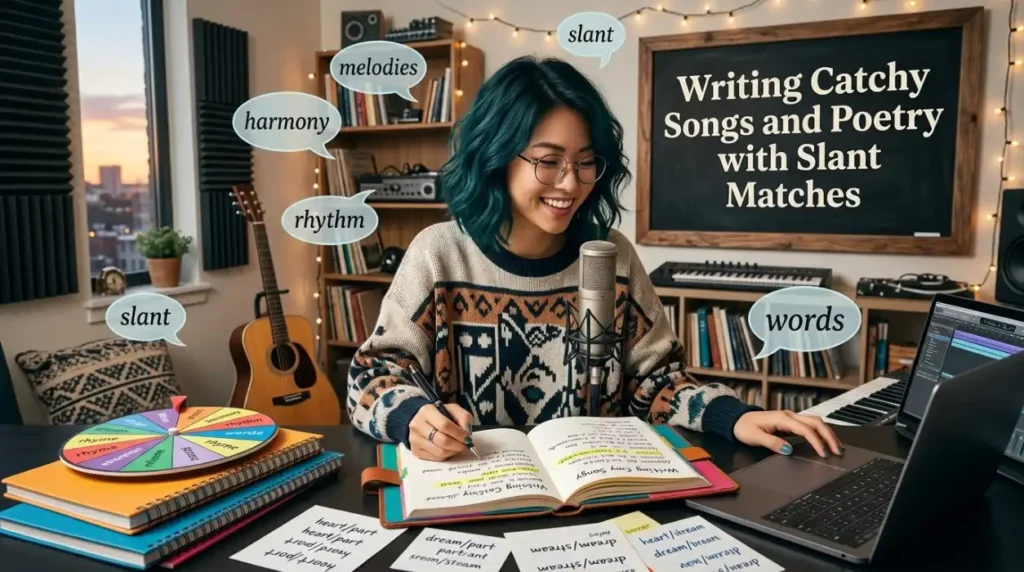
If you want to write memorable pop hooks, rap verses, or humorous poems, master the art of natural cadence. The secret to modern lyric writing lies in avoiding forced rhymes that sound clunky or artificial.
Prioritizing natural conversational speech ensures your audience connects emotionally with your message first.
Avoiding the “Greeting Card” Trap
Forced rhyming happens when a writer picks an unnatural word simply because it matches the sound of the previous line. This breaks the emotional flow of your writing and signals to the reader that you ran out of ideas.
- Write your idea down as plain prose first to capture your true meaning.
- Identify key words at the end of your thoughts and brainstorm ten potential slant matches.
- Rephrase sentence structures so natural, impactful words land on the heavy musical beats.
Building Assonance and Consonance Layers
Professional songsmiths create sonic magic by weaving assonance and consonance throughout their verses. Assonance focuses on repeating internal vowel sounds, while consonance repeats consonant textures across neighboring words.
Combining subtle sound repeats creates a smooth, velvet-like texture that pleases the ear even when end words do not match perfectly.
Using Rhyme for Practical Marketing and Social Media

Copywriters and marketing strategists frequently use acoustic techniques to craft sticky slogans, brand names, and headlines. A well-placed rhyme makes a business message instantly recognizable and easier for consumers to trust.
Behavioral scientists refer to this phenomenon as the “rhyme-as-reason effect,” where people perceive rhyming statements as more truthful.
Crafting Sticky Brand Slogans
Think of iconic slogans that stayed in public memory for decades; many rely directly on rhythmic sound matching. Short, punchy phrasing paired with end rhymes creates an effortless brand hook that customers repeat naturally.
When drafting marketing copy, keep phrases under eight words so the rhythmic punch lands cleanly without clutter.
Writing Engaging Social Media Captions
Scroll-stopping social captions leverage quick verbal hooks to grab reader attention in crowded feeds. Starting a video script or text post with a clever rhyming question piques audience curiosity immediately.
- Use rhyming couplets to introduce a common problem and offer your quick solution.
- Keep word combinations playful and lighthearted to match informal social media tones.
- Pair rhythmic captions with engaging video edits that match the natural tempo of your words.
Practice Exercise
Test your understanding of rhyming mechanics, game structures, and creative writing strategies by selecting the correct answer for each multiple-choice question below.
- Which term describes words that share similar, but not identical, vowel or consonant sounds, such as “shape” and “keep”?
A. Perfect rhyme
B. Slant or near rhyme
C. Eye rhyme
D. Internal rhyme - What is the main psychological reason rhyming messages are easier for human brains to remember?
A. Rhymes force the brain to read twice as slow.
B. Matching acoustic patterns lower cognitive load and create strong memory anchors.
C. Rhyming words are always shorter than non-rhyming words.
D. Brains can only store information that arrives in pairs of two. - In creative lyric writing, what usually causes the problem known as “forced rhyming”?
A. Choosing an unnatural word solely to match the sound at the end of a previous line.
B. Using too many slant rhymes in a single verse.
C. Writing lines that contain more than ten syllables each.
D. Refusing to use a dictionary while writing poetry. - Which rhyming game involves players finding physical objects that match a given target sound?
A. Word Chain Challenge
B. Rhyme Detective Scavenger Hunt
C. The 60-Second Lightning Round
D. Flyswatter Buzz-In - How does internal rhyming differ from traditional end rhyming in poetry?
A. Internal rhymes are only written in foreign languages.|
B. Internal rhymes place matching sound words inside the middle of a single line.
C. Internal rhymes require every word in a stanza to start with the letter P.
D. Internal rhymes can only be used in scientific textbooks.
Answer Key:
- B
- B
- A
- B
- B
FAQs
What is the easiest way to start learning fun rhyming for beginners?
Starting with simple word-association games or perfect couplets is the easiest entry point. Pick a basic noun like “cat” or “sun” and list ten matching words without worrying about making complete sense. Practice reading nursery rhymes or song lyrics out loud to build your natural sense of rhythm.
Can practicing rhyming help improve my overall vocabulary?
Yes, actively searching for words with matching sounds introduces you to new terms and synonyms you might not normally use. Using a rhyming dictionary or brainstorming slant matches expands your linguistic toolkit, encouraging you to choose more descriptive, varied vocabulary in your daily writing and speech.
What is the difference between assonance and consonance?
Assonance refers specifically to the repetition of matching vowel sounds within nearby words, such as “lean, mean, green machine.” Consonance, on the other hand, focuses on repeating internal or ending consonant sounds, as seen in “stroke of luck.” Both techniques create rich, musical textures without requiring full end rhymes.
Why do hip-hop artists use slant rhymes instead of perfect rhymes?
Slant rhymes give songwriters far greater freedom to convey complex ideas without getting trapped by limited perfect matches. Using slant rhymes allows artists to match words based on subtle vowel sounds, regional accents, and custom word stress, resulting in more natural, conversational, and surprising lyric flow.
Is rhyming useful for adult learning, or is it just for kids?
Rhyming is exceptionally beneficial for adult learning, language acquisition, and professional communication. Adults use rhythmic sound patterns to memorize complex medical terms, master foreign languages, design sticky marketing campaigns, and deliver memorable public speeches that resonate strongly with diverse audiences.
Conclusion
Embracing the art of creative wordplay opens up a world of musicality, improved memory, and expressive writing freedom. Moving away from rigid, predictable sound matches lets you discover how playful language elevates simple thoughts into unforgettable verses.
Whether you are teaching children phonics, writing your next song hook, or drafting punchy marketing copy, sound patterns build instant connection. Playing with rhythm and cadence keeps your brain active while making every writing project feel light and engaging.
Ready to transform your communication and bring fresh energy to your writing? Explore practical tools and games for fun rhyming to start crafting catchy, memorable verses today!

Jack Olive is the creative mind behind buzzgiggles.com, a fun-focused website built to bring smiles, laughter, and lighthearted entertainment to everyday life. With a passion for humor and enjoyable content, Jack Olive creates and shares playful ideas, amusing stories, entertaining discoveries, and cheerful moments designed for readers of all kinds.
Through buzzgiggles.com, Jack Olive combines creativity, curiosity, and a positive sense of humor to explore the lighter side of life. Whether visitors are looking for a quick laugh, something interesting to share, or a cheerful break from their routine, the website offers content created with fun in mind. Jack Olive believes great entertainment should be easy to enjoy, memorable, and capable of brightening someone’s day.