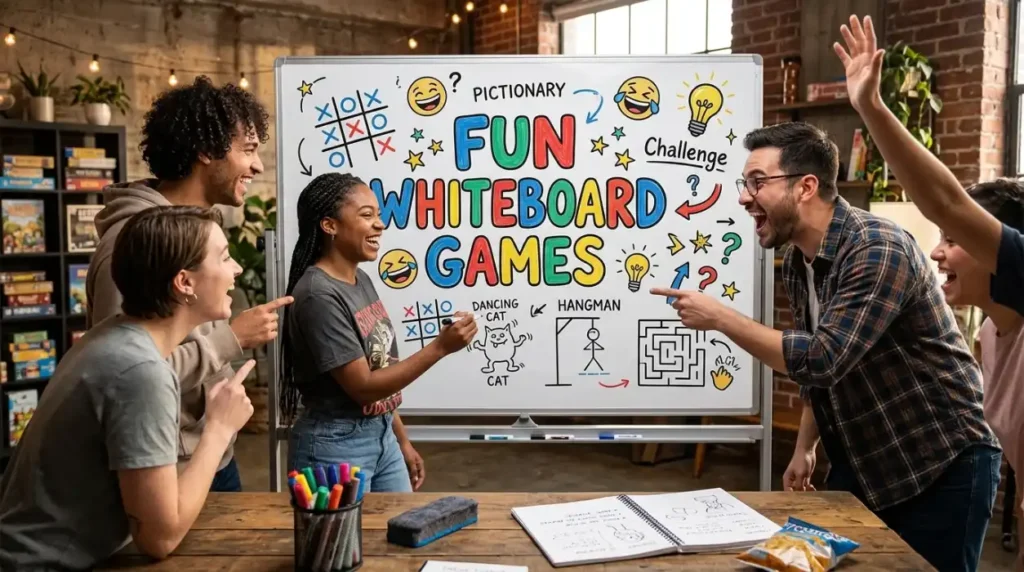
Fun whiteboard games are interactive, low-prep group activities played using dry-erase markers on a large whiteboard. Ranging from quick drawing races and vocabulary puzzles to team icebreakers, these games boost engagement, encourage active participation, and bring lively entertainment to classrooms, corporate meetings, and family parties.
Have you ever noticed how a dull room instantly wakes up the moment someone uncaps a bright dry-erase marker and draws a giant question mark on the board? Playing fun whiteboard games turns a plain surface into an exciting battleground for friendly competition, quick thinking, and shared laughter.
Whether you want to break the ice with new coworkers or keep a restless classroom focused, organizing fun whiteboard games gets everyone off their chairs and into the action.
The low-pressure nature of temporary dry-erase ink means nobody worries about making mistakes, since a quick swipe of an eraser resets the board instantly.
Let’s explore classic drawing challenges, clever word puzzles, and team-building activities that make hosting fun whiteboard games effortless for any group size.
Why Dry-Erase Boards Make the Ultimate Gaming Canvas
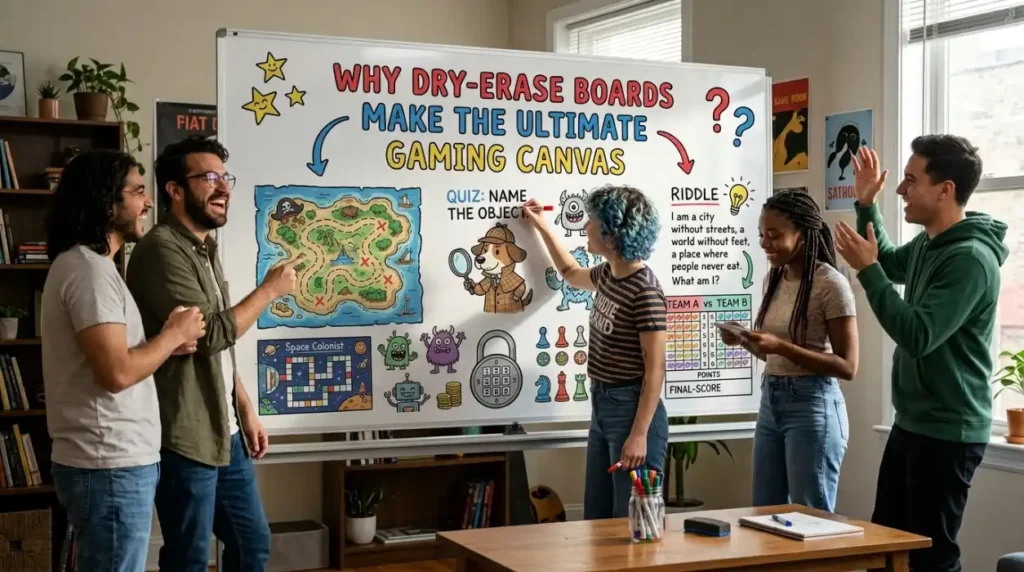
Dry-erase boards offer a unique combination of visibility, flexibility, and physical interaction that digital screens simply cannot match.
The Magic of Low-Stakes Creative Freedom
When people play games on paper or digital tablets, they often worry about messy handwriting or permanent mistakes.
Whiteboards remove that anxiety completely because every single stroke can vanish in a fraction of a second with a felt eraser.
This instant reset encourages players to take bold risks, guess wildly, and embrace funny drawing mistakes without feeling self-conscious.
Active Movement Keeps Energy Levels High
Sitting in a chair for hours drains mental focus and creates physical fatigue during long workshops or school days.
Whiteboard activities force participants to stand up, walk to the front of the room, and use big arm movements to write or draw.
This physical motion increases blood flow to the brain, which keeps players alert, energized, and deeply invested in the outcome.
Inclusive Play for Every Personality Type
Great group activities give both outspoken extroverts and quiet introverts comfortable ways to contribute to their team.
Visual artists shine during drawing rounds, quick thinkers excel at word puzzles, and strategic planners help guide team answers from the back row.
This diversity of challenge types ensures every participant feels valued and included throughout the match.
Classic Quick-Draw and Guessing Games
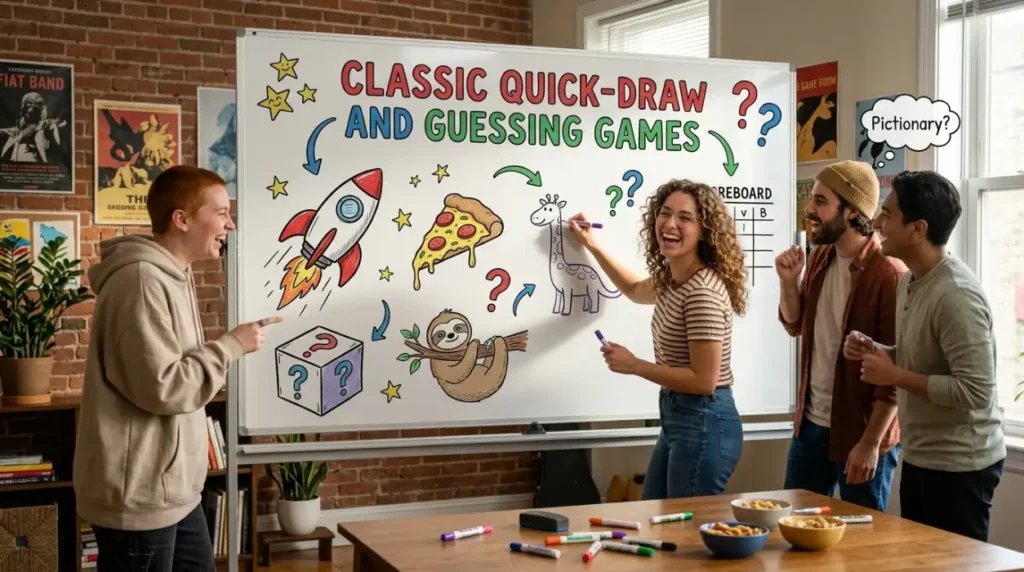
Fast-paced visual games test how quickly players can translate abstract ideas into simple, recognizable sketches under time pressure.
Pictionary Sprint and Speed Sketching
Speed sketching takes the traditional board game format and removes unnecessary rules to maximize active playing time.
- Divide your group into two equal teams and assign each team a dedicated column on the board.
- Select one drawer from each team to step up to the board simultaneously.
- Show both drawers the same secret word card, such as “submarines” or “roller coaster.”
- Start a 60-second timer and watch as both drawers race to sketch the clue while their teammates shout out rapid guesses.
Blindfolded Drawing Mishaps
Testing your spatial awareness by drawing blindfolded generates instant hilarity across the entire room.
Blindfold the active drawer, hand them a marker, and whisper a simple object like “a house with a smoking chimney and a dog.”
As they draw, their teammates must give verbal direction adjustments like “move left” or “draw higher” without touching the marker.
The Add-a-Line Monster Creation
This cooperative game works wonderfully for younger children and creative icebreaker sessions.
The host draws a single random shape on the board, such as a large oval or a wavy zig-zag line.
Each player takes turns running to the board, adding exactly one line or feature, and passing the marker to the next teammate until a funny monster appears.
Engaging Word and Vocabulary Challenges
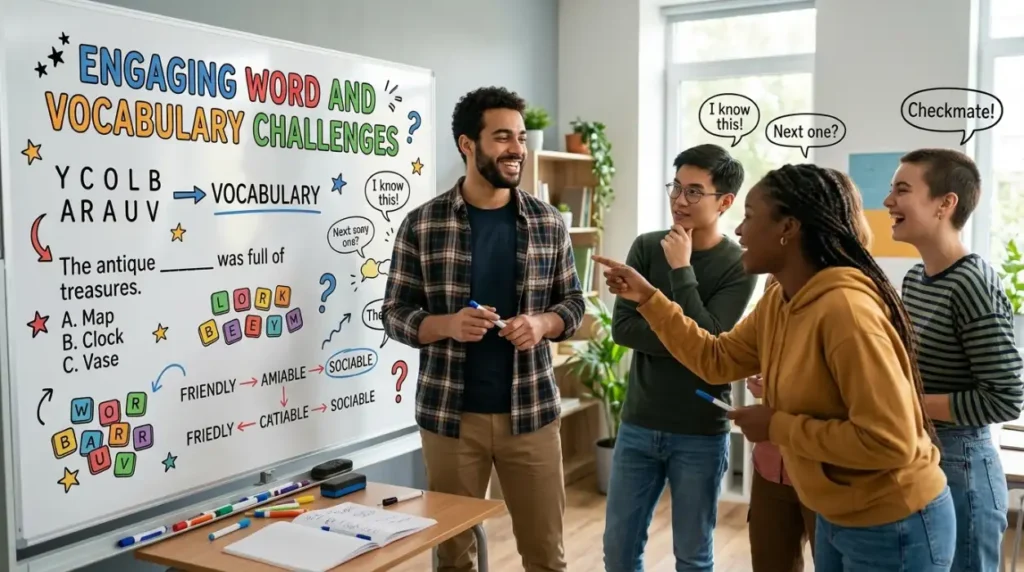
Word-based board games strengthen spelling skills, expand vocabulary, and encourage lateral thinking without feeling like schoolwork.
Snowman vs. Traditional Gallows
Many educators and party hosts prefer playing “Snowman” instead of traditional word-guessing games to keep the tone positive and gentle.
Draw a giant three-ball snowman complete with a carrot nose, top hat, stick arms, and charcoal buttons on one side of the board.
Every time players guess an incorrect letter for the secret word, erase one piece of the snowman until he completely melts away.
Categories and Letter Grid Battles
Draw a large three-by-three grid on the board and write a random letter in each square.
- Set the Clock: Give teams two minutes to find as many interconnected words as possible using adjacent letters.
- Define Categories: Require players to fit words into specific themes like “Foods,” “Cities,” or “Animals.”
- Scoring Points: Award one point for short words and three bonus points for complex words over six letters long.
Word Chain Reactions
Write a single starting word in the center of the board, such as “SUNLIGHT.”
The next player must write a new word that begins with the final letter of the previous word, branching out across the white space like a maze.
Teams earn extra points for creating sprawling word trees that reach the very edges of the frame without crossing existing lines.
Comparing Game Types for Different Group Settings
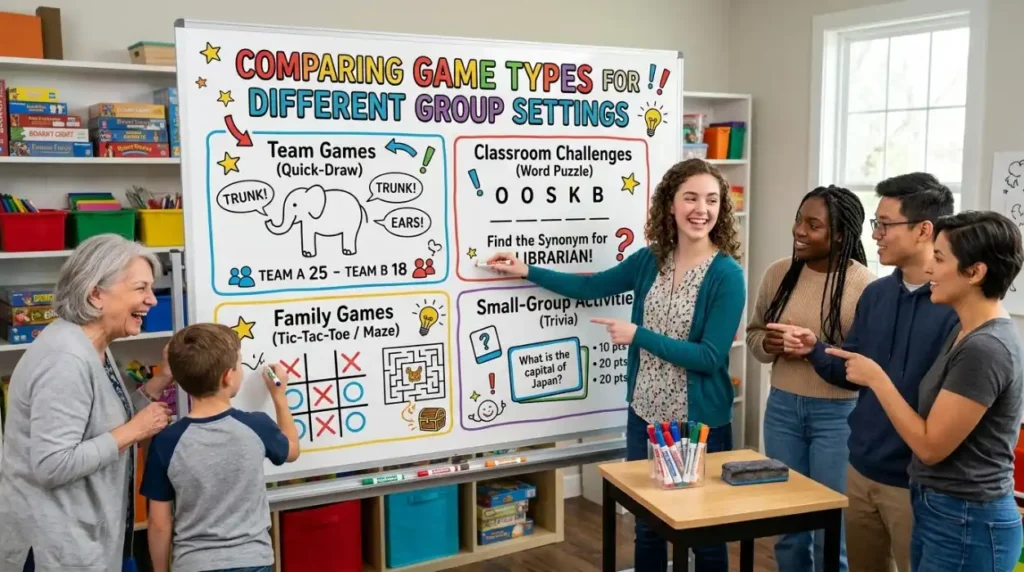
Choosing the right activity style depends heavily on your available space, group size, and time constraints.
High-Energy Team Relays and Physical Races
If you have a large board space and plenty of open room, physical relay races transform passive spectators into cheering fans.
Tic-Tac-Toe Speed Relay
Set up two identical three-by-three tic-tac-toe grids at opposite ends of a large wall-mounted board.
Divide players into two lines standing twenty feet back from the board and hand the first player in each line a marker.
When you call “Go,” the first runners sprint forward, mark an ‘X’ or ‘O’, sprint back to tag their teammate, and pass the marker like a baton.
The Sentence Building Race
This fast-paced grammar challenge tests team coordination, quick decision-making, and clear handwriting under pressure.
Write a secret list of five target words on a piece of paper for each team captain.
Runners take turns sprinting to the board to add exactly one word at a time, attempting to build a grammatically correct sentence that includes the secret target words before the opposing team finishes.
Target Throw and Math Score Keepers
Draw large concentric target rings on a magnetic whiteboard, assigning different point values like 10, 50, and 100 to each ring zone.
Have players toss soft magnetic darts or sticky balls at the board from a designated throwing line.
A team mathematician must run to the board immediately to add up the score on the board, practicing quick mental addition under pressure.
Brain Teasers, Logic Puzzles, and Visual Riddles
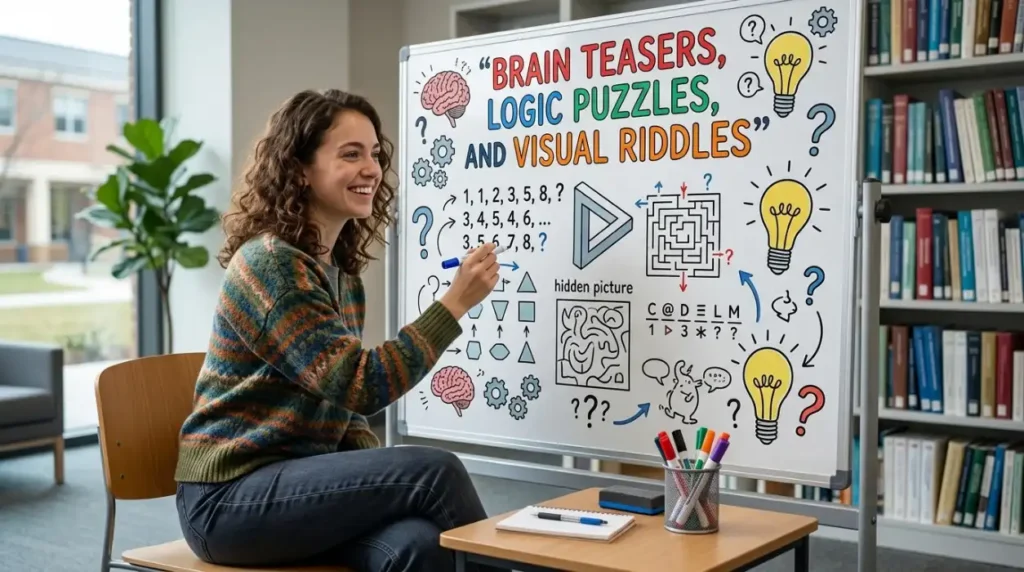
Strategic puzzles test critical thinking and encourage deep problem-solving conversations among team members.
The Nine-Dot Connectivity Puzzle
Draw a grid of nine dots arranged in a square on the board, three rows of three.
Challenge players to connect all nine dots using only four straight lines without ever lifting their marker off the board.
This classic puzzle teaches lateral thinking because solving it requires drawing line paths that extend beyond the imaginary box formed by the outer dots.
Matchstick Math Corrections
Draw incorrect math equations on the board using thick lines styled to look like old wooden matchsticks, such as 6 + 4 = 4.
Challenge players to fix the equation by moving exactly one “matchstick” line from one number or symbol to another.
Watching players test different line moves visually on the board creates an engaging, hands-on logic workshop.
Visual Rebus Puzzles
Rebus puzzles use a clever combination of pictures, letters, symbols, and spatial positioning to represent common phrases.
- Example 1: Writing the word “SECRET” inside a drawn safe box represents “Top Secret.”
- Example 2: Writing “STAND” over the word “I” represents “I understand.”
- Example 3: Writing “READING” between two drawn line borders represents “Reading between the lines.”
Best Practices for Hosts, Teachers, and Facilitators
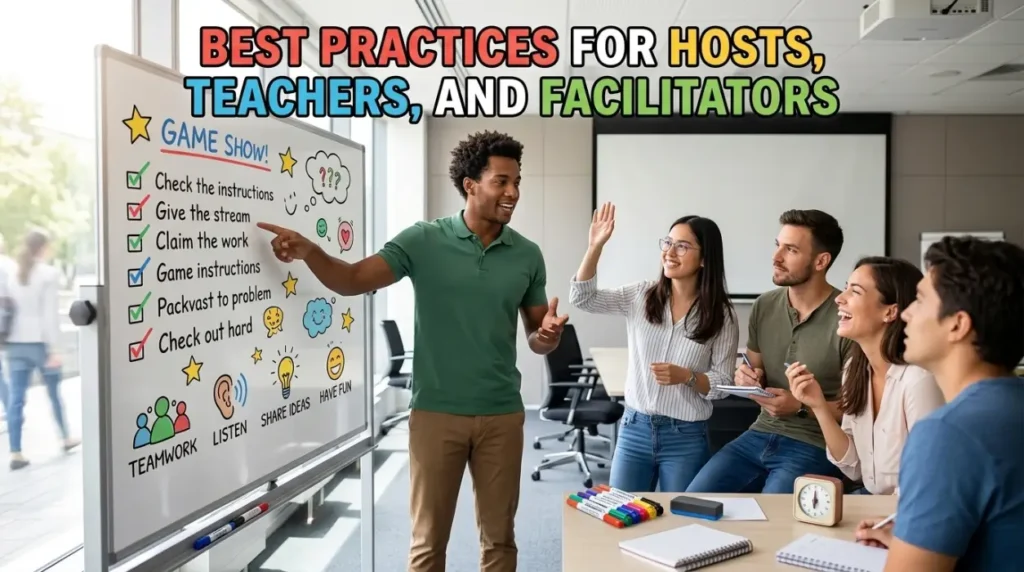
Smooth game management guarantees that every activity runs safely, fairly, and without frustrating delays.
Organizing Your Space and Marker Supplies
Always test your dry-erase markers on a small corner of the board before players arrive to ensure the ink is fresh and vibrant.
Keep plenty of dark black, blue, and green markers ready for main game lines, reserving red and orange markers for host scoring notes.
Ensure the running path between the starting line and the board is completely clear of chairs, backpacks, or loose floor cables.
Managing Noise Levels and Fair Play
Fast-paced group games can become loud quickly, especially when teams start shouting out competing answers at the same time.
Establish a clear “quiet signal,” such as raising your hand or ringing a small desk bell, to pause the game instantly when explaining rules.
Rotate team captains and drawers every single round so that every participant gets equal time at the front of the room.
Keeping Score Without Messy Board Clutter
Designate a small, dedicated column on the far right edge of the board exclusively for team names and score tallies.
Draw a thick vertical line to separate the scoring zone from the central playing canvas so that running scores do not interfere with game drawings.
Using simple tally marks makes it easy to update scores instantly between fast rounds without erasing main game grids.
Practice Exercise
Test your understanding of game facilitation, activity selection, and team management with these 5 multiple-choice questions.
- Why do dry-erase boards provide a low-pressure environment for creative drawing games?
A. Marker lines are completely permanent and cannot be altered once drawn.
B. The temporary nature of dry-erase ink allows instant erasing and mistake-free play.
C. Players are required to wear specialized protective gloves while holding markers.
D. Whiteboards can only be seen when using complex digital projection lamps. - Which game format helps improve physical energy levels and mental alertness during long sessions?
A. Silent reading from heavy printed textbooks at individual desks.
B. High-energy team relay races that require standing up and moving to the board.
C. Listening to an hour-long recorded audio lecture without taking notes.
D. Sitting perfectly still with arms crossed for thirty minutes continuously. - How does the game “Snowman” offer a positive alternative to traditional word-guessing games?
A. It eliminates the need for players to learn or guess any letters.
B. It uses a friendly melting snowman graphic to track incorrect letter guesses.
C. It requires placing real blocks of outdoor ice on top of classroom desks.
D. It forces players to spell every word backwards without using vowels. - What is the recommended way to organize your whiteboard surface during a game event?
A. Cover the entire board surface with dark black permanent ink before starting.
B. Keep a dedicated scoring column on one side, separated from the main playing canvas.
C. Allow players to scribble randomly over team scores during active rounds.
D. Refuse to use any markers other than light yellow highlighters. - How can a facilitator ensure fair participation among shy or quiet team members?
A. By allowing only the loudest participant to draw during every single round.
B. By forcing all quiet players to stand outside the room during team guessing phases.
C. By rotating drawers and team captains systematically every round so everyone plays.
D. By eliminating points whenever a player asks a question about the rules.
Answer Key:
- B
- B
- B
- B
- C
FAQs
What are the best whiteboard games for very small groups of 2 to 4 people?
Classic two-player challenges like Tic-Tac-Toe, Snowman, and collaborative storytelling chain drawings work brilliantly for small groups. These low-prep options keep turn-taking rapid and ensure everyone stays constantly engaged throughout the match.
How can I make drawing games fair for players who cannot draw well?
Focus on speed and simplicity by selecting familiar everyday objects rather than complex abstract concepts for clue cards. You can also award bonus points for clever clues or enthusiastic teamwork rather than artistic quality alone.
What should I do if dry-erase ink leaves dark stains on the board during a game?
Wipe the board using dedicated whiteboard spray or a solution of dilute isopropyl alcohol on a microfiber cloth. For stubborn permanent marker accidents, trace directly over the marks with a fresh dry-erase marker before wiping both away.
How do I prevent fast relay games from becoming unsafe or chaotic?
Enforce a strict walking-only rule if your room is tight or carpeted. Clear floor markers for waiting lines prevent players from crowding around the board or tripping over furniture during competitive moments.
Can whiteboard games be adapted for virtual or hybrid meetings?
Yes, modern video conferencing platforms include built-in digital whiteboards with shared drawing tools and sticky notes. Players can join using digital stylus pens or mouse cursors to sketch clues and solve word puzzles together online.
What marker colors work best for clear visibility across a large room?
Black, dark blue, and deep green offer the highest contrast against a white background, making them easy to read from the back row. Avoid using yellow, light orange, or pastel markers for primary game text or detailed drawing outlines.
Conclusion
Hosting fun whiteboard games is an affordable and exciting way to bring people together in classrooms, offices, or gatherings. From quick-draw challenges and word puzzles to creative guessing games, these activities can turn an ordinary whiteboard into a lively space for laughter and teamwork.
To create a memorable experience, choose games that match your group’s interests and energy level. Prepare your markers, explain the rules clearly, and give everyone a chance to participate. Simple planning can make the activity smoother and more enjoyable.
Grab your dry-erase markers, gather your team, and start playing fun whiteboard games today. Let creativity, friendly competition, and laughter make every round memorable!

Jack Olive is the creative mind behind buzzgiggles.com, a fun-focused website built to bring smiles, laughter, and lighthearted entertainment to everyday life. With a passion for humor and enjoyable content, Jack Olive creates and shares playful ideas, amusing stories, entertaining discoveries, and cheerful moments designed for readers of all kinds.
Through buzzgiggles.com, Jack Olive combines creativity, curiosity, and a positive sense of humor to explore the lighter side of life. Whether visitors are looking for a quick laugh, something interesting to share, or a cheerful break from their routine, the website offers content created with fun in mind. Jack Olive believes great entertainment should be easy to enjoy, memorable, and capable of brightening someone’s day.