
Fun spelling worksheets are interactive learning printables that use crosswords, word searches, cryptograms, and visual drawing challenges to teach literacy skills. Unlike rote repetition sheets, these creative activities transform vocabulary memorization into an enjoyable puzzle-solving game that improves letter pattern recognition and reading confidence for young learners.
Have you ever watched a young child groan when handed a stack of traditional vocabulary drills? Swapping dry word lists for interactive fun spelling worksheets turns tedious afternoon study sessions into an exciting game.
Kids naturally learn faster when study materials look like playful puzzles rather than boring homework assignments.
Using creative fun spelling worksheets helps students build muscle memory, master tricky phonetic patterns, and retain vocabulary words without tears.
Ready to transform your home or classroom study routine with practical fun spelling worksheets? Let’s explore puzzle formats, age-appropriate activities, free design tips, and multisensory learning hacks together!
The Cognitive Science Behind Playful Literacy Tools
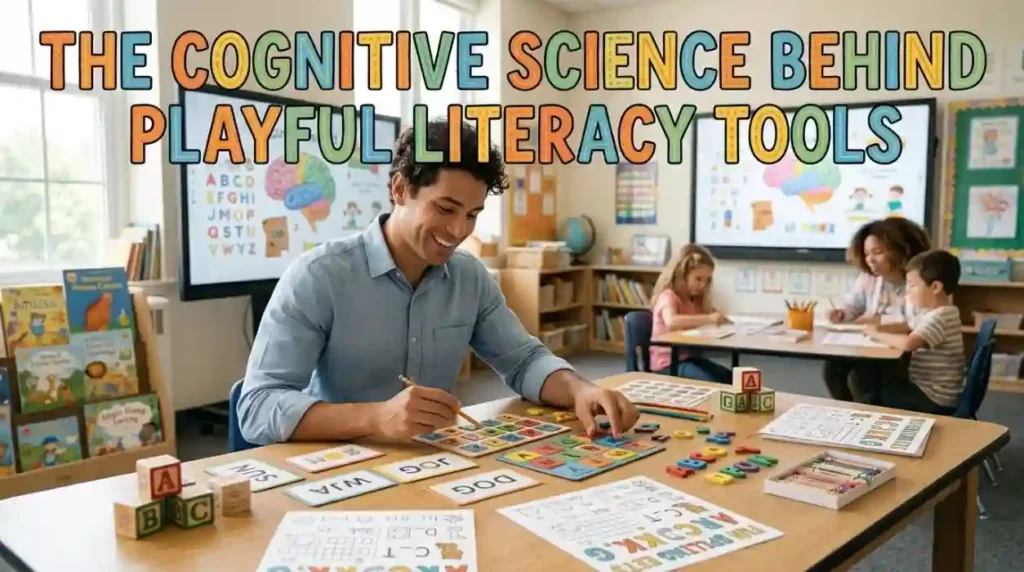
It is easy to assume that any sheet filled with printed letters serves the same educational purpose. However, pediatric cognitive researchers have discovered that interactive design dramatically alters how the brain stores written language patterns.
When children encounter words within a playful context, their brains release dopamine, which strengthens memory formation.
Understanding this mental process helps parents and teachers choose far more effective educational activities.
Moving Beyond Rote Memorization and Tracing
Traditional spelling practice relies heavily on rote repetition, writing the same word ten times in a row down a lined sheet. While this mechanical method places words in short-term memory, it rarely helps children understand how letter sounds work together.
Interactive sheets challenge the brain to analyze letter positions, recognize visual shapes, and solve structural puzzles.
This active problem-solving approach transfers vocabulary directly into long-term memory far more efficiently.
Visual Pattern Recognition and Orthographic Mapping
Before a child can spell a word automatically, their mind must construct a mental blueprint of its letter sequences, known as orthographic mapping. Visual activities like word searches and missing-letter grids force the eye to scan for specific letter clusters.
As kids search for combinations like “th” or “ight,” their brains recognize common phonetic structures.
This visual familiarity translates directly into faster reading fluency and fewer spelling errors in creative writing.
Popular Categories of Creative Vocabulary Worksheets
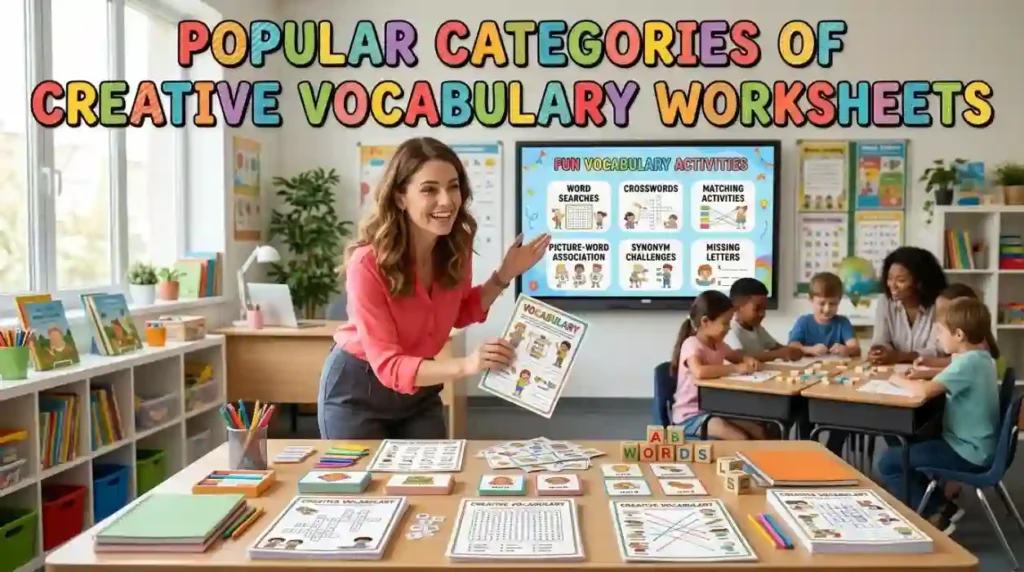
Not all educational printables are created equal; different puzzle types target specific learning styles and cognitive skills. Combining multiple activity styles keeps children curious while reinforcing vocabulary from several distinct angles.
Varying your activity selection prevents learning fatigue and keeps afternoon study sessions fresh.
Here is a helpful summary comparing popular worksheet categories, target skills, and ideal age ranges.
1. Crossword Puzzles for Contextual Learning
Crossword puzzles are fantastic for older elementary students because they combine spelling accuracy with reading comprehension. Instead of simply copying letters, students must read written clues, think of matching vocabulary, and fit letters into designated boxes.
If a student spells a word incorrectly, the intersecting letters will not align properly with neighboring answers.
This self-correcting design teaches children to catch their own errors without needing constant adult intervention.
2. Word Search Grids for Visual Scanning
Word searches are an exceptional tool for early readers who are building confidence with letter order. Searching through a grid forces the brain to isolate initial letters, follow directional paths, and double-check letter groupings.
You can customize word searches around specific phonics rules, such as words ending in silent “e” or words containing vowel diphthongs.
They serve as wonderful, low-stress warm-up activities at the start of a study period.
3. Secret Code Breakers and Cryptograms
Kids love playing secret agent, making cryptogram worksheets an instant hit in upper elementary classrooms. In a code-breaker activity, each letter of the alphabet is replaced by a unique symbol, number, or picture key.
Students must decode secret messages or mystery jokes by translating the symbols back into correct letters.
This deductive process reinforces letter-sound relationships while building critical thinking skills.
Age-Appropriate Activity Designs for Every Grade Level
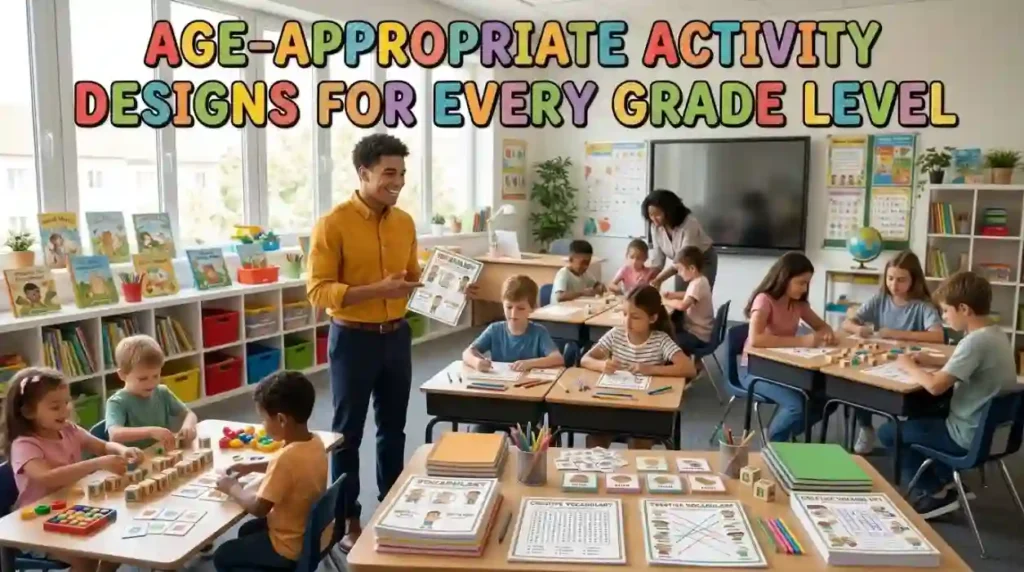
Children go through distinct developmental stages when learning to read and write English. Giving a kindergartener a complex crossword puzzle causes immediate frustration, while giving a fifth-grader a simple line-tracing page leads to instant boredom.
Tailoring your activity formats to match your child’s developmental stage ensures maximum engagement and learning growth.
Let’s examine how to structure activities for three primary age brackets.
Kindergarten to First Grade: Visual and Tactile Focus
Young learners who are just mastering letter sounds need large fonts, colorful illustrations, and plenty of physical drawing space. Activities should feature clear picture clues alongside fill-in-the-blank letter spots.
- Missing Vowel Cut-and-Paste: Kids cut out printed paper vowels and glue them into missing word spaces under pictures.
- Rainbow Writing Sheets: Children trace target words using three different colored crayons to build muscle memory.
- Sound-Matching Mazes: Students draw a line through a maze by following pictures that start with the same letter sound.
Second Grade to Third Grade: Phonics and Pattern Building
At this stage, children are transitioning from simple three-letter words to complex phonetic patterns, compound words, and silent letters. Worksheets should challenge them to sort words into categories based on structural spelling rules.
- Word Sorting Trees: Students write target words onto designated branches based on vowel sounds or prefix types.
- Scrambled Letter Anagrams: Kids unscramble mixed-up letter clusters to reveal their weekly vocabulary words.
- Rhyming Word Ladders: Students change one letter at a time to climb up a drawn ladder of rhyming words.
Fourth Grade and Beyond: Vocabulary Expansion and Etymology
Older students need activities that connect spelling to meaning, roots, prefixes, and suffixes. Worksheets should incorporate dictionary skills, sentence construction, and playful word games that stretch their vocabulary.
- Prefix and Suffix Matrix Grids: Students combine base root words with different prefixes and suffixes to create valid words.
- Homophone Mystery Stories: Kids read short, humorous stories and circle the correct homophone choice in every sentence.
- Vocabulary Word Ladders: Students alter single letters based on definition clues to transition from a starting word to a final word.
Multisensory Hacks: Combining Paper Sheets with Hands-On Play
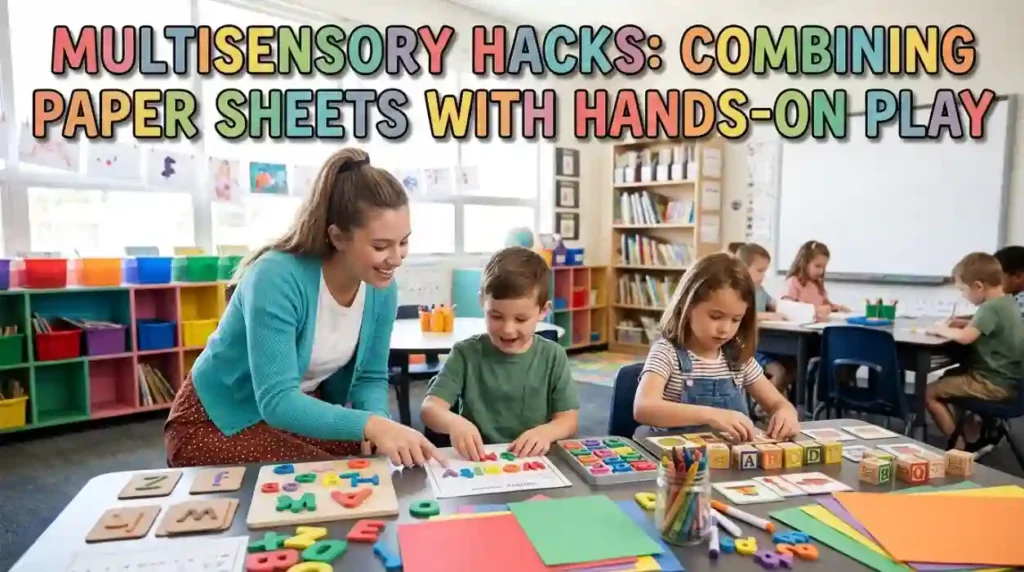
Worksheets perform best when integrated into a rich, multisensory learning environment rather than used in total isolation. Combining paper activities with tactile materials engages multiple sensory pathways in the brain simultaneously.
This multisensory approach is especially powerful for kinesthetic learners who struggle to sit still with just a pencil.
Here are four simple ways to turn flat paper activities into 3D learning games.
Play-Dough and Stamp Integration
Place your printed activity sheet inside a clear plastic dry-erase sleeve on your table. Instead of writing answers with a pencil, have your child roll out strips of play-dough to form letters directly over the worksheet spaces.
Alternatively, provide alphabet dough stamps so children can physically press letters into dough to complete each word on the page.
The tactile resistance of the dough reinforces muscle memory while keeping young fingers active and happy.
Sensory Bin Letter Scavenger Hunts
Fill a plastic storage bin with dried rice, beans, or shredded paper, and hide plastic magnetic letters inside. When your child reaches a fill-in-the-blank question on their worksheet, they must dig through the sensory bin to find the physical matching letter.
Once they retrieve the correct letter from the bin, they place it onto their paper sheet and write it down.
Adding this simple physical search turns quiet seatwork into an active treasure hunt.
How to Create Your Own Custom Worksheets at Home
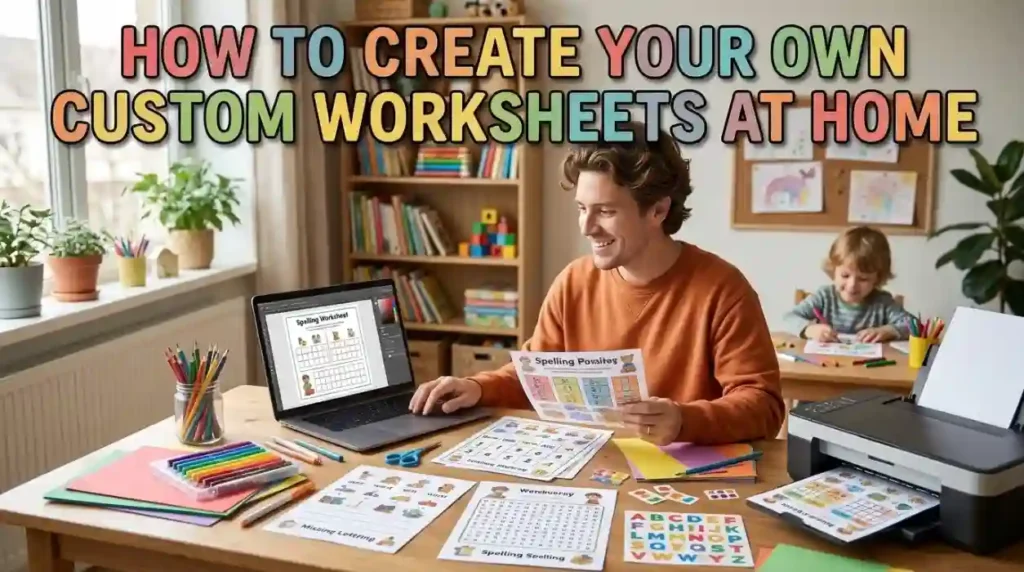
While you can purchase commercial activity books, creating custom sheets tailored to your child’s exact school vocabulary list is remarkably easy. Modern online software and free print generators allow parents and teachers to build polished templates in just a few minutes.
Customized sheets allow you to incorporate your child’s favorite hobbies, pet names, and personal interests directly into the activities.
Follow this simple four-step guide to design your own custom printables at home.
- Compile Your Weekly Word List: Gather ten to fifteen target vocabulary words from your child’s current reading curriculum.
- Select a Generator Tool: Use free online puzzle makers to generate custom word searches, crosswords, or anagrams instantly.
- Add Personal Clues and Themes: Customize clue descriptions with funny family references or favorite cartoon characters.
- Print and Add Visual Elements: Print your custom creation and invite your child to color the margins with doodles and illustrations.
Practice Exercise
Test your knowledge of educational activities, cognitive phonics concepts, age suitability, and multisensory hacks with this quick five-question multiple-choice quiz.
- Why are interactive puzzle sheets more effective for long-term memory than writing words ten times in a row?
A. They make paper weigh half as much in a backpack
B. They trigger active problem-solving and orthographic mapping in the brain
C. They turn black-and-white ink into gold automatically
D. They eliminate the need for children to learn reading - Which worksheet activity type is best suited for teaching older elementary kids definitions and context clues?
A. Simple line-tracing pages
B. Crossword puzzles with written clues
C. Blank sheets of graph paper
D. Connect-the-dots picture sheets - What is the core cognitive benefit of word search puzzles for young readers?
A. They teach children how to draw realistic animals
B. They improve visual pattern scanning and letter-sequence recognition
C. They eliminate the need for pencils
D. They teach kids how to type on digital keyboards - How does sliding a printed worksheet inside a clear plastic sleeve help home learning?
A. It allows kids to write answers with dry-erase markers and reuse the page multiple times
B. It makes the paper completely invisible to the human eye
C. It doubles the physical size of the printed font
D. It prevents paper from absorbing room light - What type of activity is ideal for kindergarteners developing early fine motor control and letter awareness?
A. Complex college-level etymology charts
B. Missing-vowel cut-and-paste activities with picture clues
C. Translating ancient Greek root words
D. Writing multi-page essays
Answer Key:
- B
- B
- B
- A
- B
FAQs
How many spelling worksheets should a child complete each week?
Completing two to three short, 15-minute activity sheets per week is ideal for most elementary students. Keeping sessions brief and engaging prevents cognitive fatigue while providing consistent reinforcement throughout the school week.
Can digital spelling apps replace printable paper worksheets entirely?
While digital literacy apps offer interactive fun, physical handwriting on paper builds superior fine motor skills and spatial awareness. Combining digital games with tactile paper activities provides the most balanced and comprehensive learning experience.
What should I do if my child gets frustrated by difficult puzzle sheets?
Step in immediately to offer gentle scaffolding before frustration leads to tears or avoidance. Work through the first two questions together out loud, or provide a visible word bank at the top of the page for reference.
How do I make spelling practice fun for a child with dyslexia?
Focus heavily on multisensory activities that incorporate color-coding, large dyslexic-friendly fonts, and physical objects like dough or letter tiles. Avoid timed speed drills and high-density text grids that create visual strain and anxiety.
Are free printable spelling worksheets high quality for educational use?
Yes, thousands of veteran teachers share high-quality, research-backed printables online for free. Look for clean layouts with clear fonts, age-appropriate instructions, and minimal clutter to ensure high educational value.
Conclusion
Incorporating engaging, fun spelling worksheets into your child’s weekly routine transforms routine homework into a joyful adventure of discovery. From crosswords and secret codes to multisensory dough stations, creative printables build reading confidence and long-term literacy skills effortlessly.
Remember that education works best when it nurtures a child’s natural curiosity and love of play.
Gather your crayons, print out a fresh puzzle sheet today, and watch your young learner shine!

Jack Olive is the creative mind behind buzzgiggles.com, a fun-focused website built to bring smiles, laughter, and lighthearted entertainment to everyday life. With a passion for humor and enjoyable content, Jack Olive creates and shares playful ideas, amusing stories, entertaining discoveries, and cheerful moments designed for readers of all kinds.
Through buzzgiggles.com, Jack Olive combines creativity, curiosity, and a positive sense of humor to explore the lighter side of life. Whether visitors are looking for a quick laugh, something interesting to share, or a cheerful break from their routine, the website offers content created with fun in mind. Jack Olive believes great entertainment should be easy to enjoy, memorable, and capable of brightening someone’s day.