
A fun story world is a fictional setting designed with unique rules, geography, cultures, and internal logic that captivates readers and fuels imagination. By balancing creative freedom with clear consistency, writers build immersive environments where characters explore, face meaningful stakes, and bring engaging stories to life.
Have you ever closed a fantasy book or paused a favorite video game just to ponder how its fictional universe was built? Designing your own fun story world is one of the most exciting creative adventures a writer can undertake.
Building a fun story world gives your imagination complete freedom while providing your characters with a meaningful place to live, explore, and face challenges.
Whether you are plotting your first fantasy novel, launching a tabletop roleplaying campaign, or simply sketching maps for enjoyment, learning how to structure a fun story world changes everything.
Let’s explore key elements of setting design, geography rules, magic systems, and cultural details to make your fictional universe feel vibrantly real and endlessly entertaining.
The Foundations of Worldbuilding
Worldbuilding is the art of constructing an imaginary universe from scratch. Every legendary fictional universe starts with a simple idea that grows into a complete environment with physical, social, and cultural structures.
When you begin building your setting, focus on the elements that directly impact your main plot and characters.
Establishing Internal Consistency
Internal consistency means that your universe follows its own rules continuously without breaking them arbitrarily. If magic requires rare gemstones to function on page ten, it should still require those same gemstones on page three hundred.
Readers happily suspend disbelief for talking dragons or faster-than-light space travel, but they lose trust when a story breaks its established internal rules.
- Rule Clarity: Define basic laws of physics, magic, or technology early in your planning process.
- Cause and Effect: Ensure historical events and natural disasters leave lasting footprints on your geography and societies.
- Logical Limitations: Give every powerful ability, weapon, or piece of technology a clear cost or drawback.
- Systemized Knowledge: Keep a centralized world bible or digital notebook to track character names, locations, and historical dates.
Balancing Realism and Imagination
You do not need an advanced degree in geology or sociology to create a believable setting. Believability comes from grounding foreign ideas in familiar human experiences and natural logic.
If your setting features floating islands in the sky, think about how people harvest fresh water, trade goods, and protect themselves from high winds.
Crafting Unique Geography and Maps
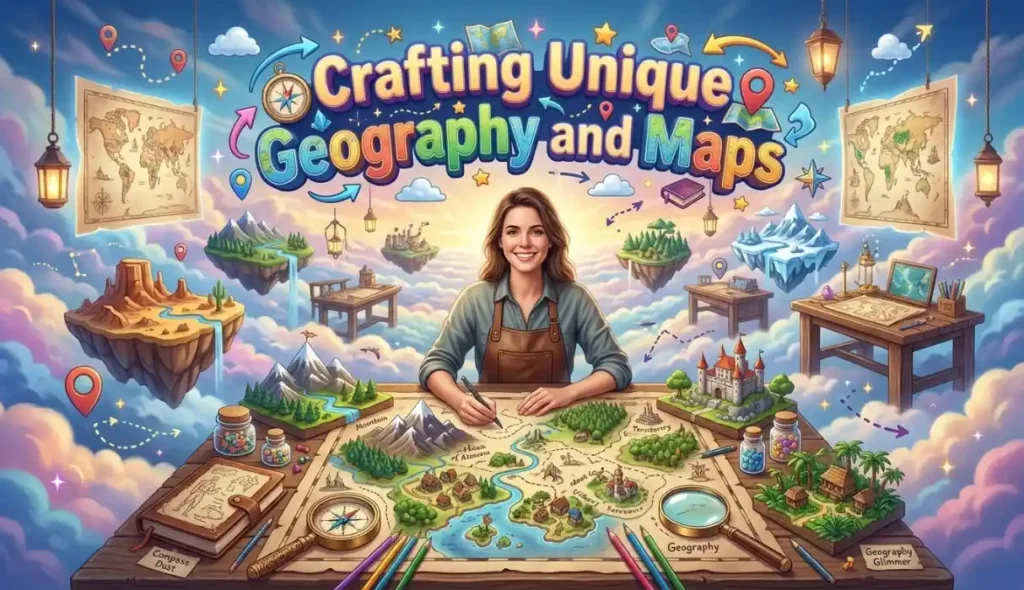
Physical geography shapes how societies grow, where cities sit, and how wars unfold. Rivers, mountain ranges, and climate zones influence trade routes, language spread, and local diets.
Designing your map visually makes spatial relationships clear for both you and your readers.
Understanding River Patterns and Mountain Chains
Natural landforms follow basic patterns that give your map an authentic feel. Mountains form long ranges where tectonic plates collide, and rivers always flow downhill along the path of least resistance toward larger bodies of water.
Avoid drawing rivers that split into multiple branches flowing across entire continents, as real rivers merge together as they head toward the ocean.
Climate Zones and Natural Resources
- Biome Placement: Place deserts, rainforests, tundra, and grasslands where mountain rain shadows and global winds naturally dictate.
- Resource Hotspots: Scatter precious metals, fertile soil, and timber forests across regions to create natural zones of economic power.
- Natural Trade Chokepoints: Design narrow mountain passes, shallow river crossings, and sea straits that nations fight to control.
- Urban Settlement Logic: Position major capital cities along coastal harbors or at the junction of major rivers where trade thrives.
Developing Cultures, Traditions, and Daily Life
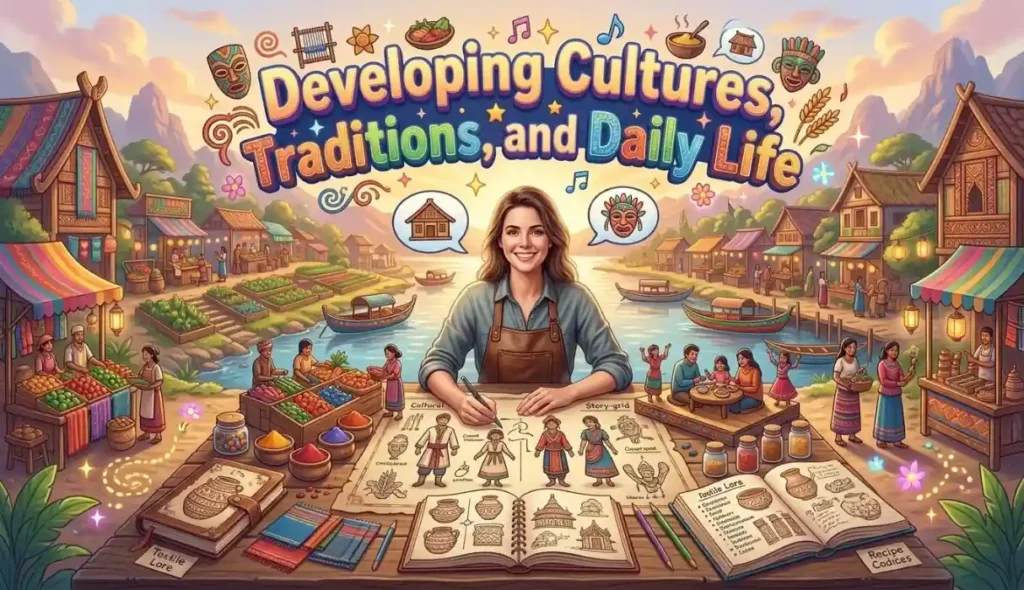
A physical landscape remains empty until populated by distinct cultures with rich histories. Culture encompasses everything from grand religious festivals to everyday table manners and regional jokes.
Focusing on small daily details makes your fictional societies feel authentic and lived-in.
Food, Fashion, and Architecture
What people eat depends heavily on local agriculture and climate. A desert society might rely on preserved dates, goat cheese, and flatbreads, while an island nation dines on fresh kelp, shellfish, and roasted fish.
Architecture similarly reflects climate needs: steep pitched roofs shed heavy snow, while thick adobe walls keep interior rooms cool under burning suns.
Language, Slang, and Idioms
Languages shape how people perceive their surroundings. A culture living in eternal ice will have dozens of words for frozen precipitation, while a seafaring society will use nautical terms in everyday conversations.
Inventing regional proverbs and casual slang gives your characters distinct voices that reflect their upbringing and homeland.
Designing Systems of Magic and Technology
Whether your setting uses ancient elemental spells or hyper-advanced quantum machinery, clear systems define what is possible within your narrative.
Decide early whether your system is hard, soft, or a unique blend of both approaches.
Hard Magic vs. Soft Magic Systems
Hard magic systems feature strict rules, precise costs, and predictable outcomes that function almost like natural sciences. Soft magic systems preserve mystery, wonder, and unpredictability, focusing on atmosphere rather than detailed mechanics.
Choosing between hard and soft systems depends on whether you want characters to solve plot problems using clever spell mechanics or experience awe in the face of ancient forces.
The Importance of Costs and Limitations
Power without limits destroys narrative tension and removes emotional stakes. The limitations of a magic or technological system are often far more interesting than what the system can achieve.
- Physical Fatigue: Channeling energy drains bodily stamina, requiring rest or nutritional recovery.
- Rare Materials: Advanced devices require scarce minerals or specialized fuel sources to operate.
- Moral Consequences: Using forbidden powers corrupts the mind or strains relationships within the community.
- Environmental Backlash: Unleashing massive energy destabilizes weather patterns or corrupts nearby natural land.
Weaving History into Active Storytelling
A rich history gives your setting depth, but dumping pages of historical lore bores readers quickly. The best worldbuilding surfaces naturally through character interactions, architectural ruins, and local traditions.
Show how past wars, ancient discoveries, and fallen empires actively shape the present day.
Showing History Through Artifacts and Ruins
Instead of explaining an ancient war through a long textbook summary, let your characters walk past a crumbling stone monument covered in moss. Have a shopkeeper accept old silver coins from a defunct kingdom, or feature a festival celebrating an ancient harvest victory.
These subtle touches inform readers about the past while keeping the current scene moving forward smoothly.
Avoiding the Dreaded Exposition Dump
Resist the urge to explain everything you have created in your world bible all at once. Reveal details only when they become relevant to character motivations or immediate scene conflicts.
Trust your readers to assemble the puzzle pieces as they travel deeper into your narrative universe.
Practice Exercise
Test your understanding of setting design, geography rules, and magic systems with these 5 multiple-choice questions.
- Why is internal consistency crucial when designing a fictional universe?
A. It allows writers to change rules randomly without explanation.
B. It maintains reader trust by ensuring established laws are followed continuously.
C. It guarantees that every story becomes an immediate bestseller.
D. It eliminates the need to draw physical maps or design cultures. - Which geographic pattern reflects real-world physics on planetary maps?
A. Rivers split into dozens of branches while flowing up mountain slopes.
B. Rivers merge and flow downhill toward larger bodies of water.
C. Deserts only form on small tropical islands surrounded by cold ocean water.
D. Mountain ranges appear as perfectly square isolated blocks in ocean basins. - What distinguishes a hard magic system from a soft magic system?
A. Hard magic systems use smooth gemstones, while soft magic systems use wooden wands.
B. Hard magic systems feature strict rules and costs, while soft magic systems emphasize mystery.
C. Hard magic systems can only be used by villains, while soft magic systems belong to heroes.
D. Hard magic systems require no energy, while soft magic systems cause instant exhaustion. - How can a writer introduce historical lore without boring readers with massive exposition dumps?
A. Include a fifty-page historical encyclopedia in the very first chapter.
B. Interrupt action scenes continuously to explain ancient family trees.
C. Reveal past events naturally through physical ruins, traditions, and active character interactions.
D. Delete all historical details completely so the setting has zero past events. - What happens when a writer gives a magic or technology system clear costs and limitations?
A. Story tension increases because characters must overcome meaningful restrictions.
B. The story becomes unreadable because characters cannot perform actions.
C. Magic disappears from the setting entirely after the first chapter.
D. Readers lose interest because superpowers become too easy to use.
Answer Key:
- B
- B
- B
- C
- A
FAQs
How much worldbuilding should I complete before I start writing my story?
Complete just enough setting design to understand your main geography, core cultural rules, and magic limits. Building too much background lore upfront can lead to procrastination, while planning basic foundations gives you a solid framework to start writing immediately.
Can I build a setting that blends magic and advanced technology?
Yes, combining magic and high technology creates fascinating settings known as science-fantasy or magitech. Focus on explaining how magic and technology interact, whether they rely on the same energy sources, and how society balances ancient spells with modern machines.
How do I make my fictional cultures feel unique instead of generic fantasy tropes?
Avoid relying entirely on standard tropes by combining unexpected cultural elements, geography types, and economic systems. Mix historical inspirations from different real-world eras with unique local resources to create fresh traditions, diets, and social structures.
What is the best way to track all my worldbuilding notes and ideas?
Use organized digital notebooks, wiki software, or physical binder systems categorized by geography, history, characters, and magic rules. Keeping an indexed world bible makes cross-referencing names, locations, and dates quick and effortless during deep writing sessions.
How do I know if I am over-explaining my world to readers?
If your dialogue sounds like a history lecture or your narrative stops frequently for background explanations, you are likely over-explaining. Trim non-essential background details and reveal lore only when it directly impacts character choices or active plot progression.
Conclusion
Creating your own fun story world is a rewarding creative process that brings your fictional projects to life with color, logic, and wonder. By establishing consistent rules, logical geography, rich cultures, and balanced magic systems, you construct an environment where memorable adventures unfold naturally.
Remember that worldbuilding serves to support your characters and engage your readers, so focus on details that make your setting feel vibrant and authentic.
Grab your notebook, start sketching your map, and craft an unforgettable realm that readers will love exploring again and again!

Jack Olive is the creative mind behind buzzgiggles.com, a fun-focused website built to bring smiles, laughter, and lighthearted entertainment to everyday life. With a passion for humor and enjoyable content, Jack Olive creates and shares playful ideas, amusing stories, entertaining discoveries, and cheerful moments designed for readers of all kinds.
Through buzzgiggles.com, Jack Olive combines creativity, curiosity, and a positive sense of humor to explore the lighter side of life. Whether visitors are looking for a quick laugh, something interesting to share, or a cheerful break from their routine, the website offers content created with fun in mind. Jack Olive believes great entertainment should be easy to enjoy, memorable, and capable of brightening someone’s day.